
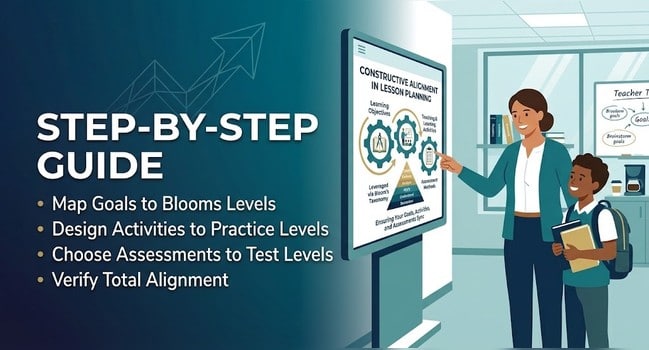
Constructive Alignment in Lesson Planning with Bloom’s Taxonomy
A lesson plan can contain a strong learning objective, engaging activities, and a well designed assessment and still miss the mark.
The problem often comes down to alignment.
For example, a teacher might write:
“Students will analyze the causes of climate change.”
The lesson may include a discussion and a video about climate change. But at the end, students complete a 10 question quiz that asks them to define greenhouse gases and recall dates.
The teacher covered the topic, but the lesson didn’t assess the stated learning outcome.
Constructive alignment helps prevent this problem.
Developed by education researcher John Biggs, constructive alignment connects three parts of teaching:
- Intended Learning Outcomes (ILOs), or Student Learning Outcomes (SLOs)
- Teaching and Learning Activities (TLAs)
- Assessment Tasks (ATs)
The basic idea is straightforward:
Students should practice the kind of thinking you expect them to demonstrate, and the assessment should measure that same thinking.
Bloom’s Revised Taxonomy gives teachers a practical framework for determining the cognitive level of an outcome and selecting activities and assessments that match it.
This guide shows you how to build that alignment step by step.
What Is Constructive Alignment?
Constructive alignment combines two ideas.
- Constructive refers to the idea that learners construct meaning through active engagement with content and learning experiences.
- Alignment means that the intended outcomes, learning activities, and assessments work toward the same learning target.
Think of the lesson as a chain:
Learning outcome → Learning activity → Assessment evidence
If one link doesn’t match the others, the lesson can lose its instructional coherence.
Suppose your SLO says:
“Students will evaluate the reliability of two online information sources using established credibility criteria.”
That’s an evaluation task.
Students therefore need activities that allow them to practice evaluating sources. They might:
- Examine examples of reliable and unreliable sources
- Learn credibility criteria
- Compare two sources
- Discuss evidence with peers
- Practice applying a credibility checklist
The final assessment should then ask students to evaluate sources, not simply define “credible source.”
An aligned lesson might look like this:
| Component | Example |
|---|---|
| SLO | Students will evaluate the reliability of two online sources using five credibility criteria. |
| Bloom’s Level | Evaluate |
| TLA | Students compare sources using a credibility checklist and discuss their judgments. |
| Assessment | Students independently evaluate two unfamiliar sources and justify their conclusions using evidence. |
The three components point toward the same cognitive task.
Step 1: Write Observable Student Learning Outcomes
Start with what students should be able to do by the end of the lesson.
Avoid starting with what you intend to teach.
That’s a subtle but important change.
Instead of:
“I will teach students about the water cycle.”
Write:
“Students will explain how evaporation, condensation, and precipitation interact within the water cycle.”
The second statement focuses on student performance.
Avoid Vague Learning Outcomes
Words such as these can create problems:
- Understand
- Know
- Learn
- Become familiar with
- Be aware of
- Appreciate
These verbs don’t tell you exactly what students should demonstrate.
You can’t easily observe whether a student “understands” something without defining what that understanding looks like.
Replace vague verbs with observable actions.
| Instead of | Try |
| Understand | Explain |
| Know | Identify |
| Learn | Apply |
| Be familiar with | Describe |
| Appreciate | Evaluate |
| Become aware of | Identify |
| Understand the causes | Analyze the causes |
The replacement depends on what you actually want students to accomplish.
Use the SLO Formula
A useful structure is:
By the end of this lesson, students will be able to + [action verb] + [content] + [condition or context].
For example:
Weak SLO:
Students will understand fractions.
Stronger SLO:
Students will compare two fractions with different denominators and justify which fraction has the greater value.
Another example:
Weak:
Students will understand historical sources.
Strong:
Students will evaluate the credibility of two historical sources using authorship, purpose, context, and supporting evidence.
The stronger outcomes give students and teachers something observable to work with.
Step 2: Identify the Knowledge Type
Bloom’s cognitive process represents one part of the equation.
Teachers should also consider what kind of knowledge students need to work with.
Anderson and Krathwohl’s revised framework identifies four broad knowledge types:
| Knowledge Type | What It Includes | Example |
| Factual | Terms, details, basic information | Vocabulary, dates, names |
| Conceptual | Relationships, principles, classifications | Ecosystems, democracy, mathematical concepts |
| Procedural | Methods, techniques, processes | Solving equations, conducting an experiment |
| Metacognitive | Awareness of one’s own learning | Choosing a study strategy and explaining why |
This distinction helps you create more precise outcomes.
For example:
“Students will identify the stages of mitosis.”
This primarily involves factual knowledge.
But:
“Students will explain how errors during mitosis can affect cell development.”
requires conceptual knowledge and a deeper cognitive process.
Step 3: Choose the Bloom’s Taxonomy Level
Once you’ve written the outcome, identify the cognitive work students must perform.
Anderson and Krathwohl’s Revised Bloom’s Taxonomy contains six cognitive process levels:
| Level | Cognitive Process | Common Verbs | What Students Do |
| 1 | Remember | Define, list, recall, identify | Retrieve information |
| 2 | Understand | Explain, summarize, classify, compare | Construct meaning |
| 3 | Apply | Solve, demonstrate, use, implement | Use knowledge in a situation |
| 4 | Analyze | Differentiate, organize, categorize, contrast | Examine relationships and parts |
| 5 | Evaluate | Critique, justify, judge, defend, assess | Make judgments using criteria |
| 6 | Create | Design, formulate, construct, produce | Produce something new |
Remember that verbs don’t automatically determine cognitive level.
For example, “identify” usually signals remembering, but the context matters.
A teacher should ask:
What mental work must the student actually perform?
That’s more important than simply selecting a verb from a list.
Level 1: Remember
Students retrieve information from memory.
Examples:
- Define photosynthesis.
- List the three branches of government.
- Identify the parts of a cell.
- Recall the steps of the scientific method.
Suitable assessments:
- Selected response questions
- Matching
- Flashcards
- Short answer recall
- Labeling activities
Level 2: Understand
Students explain or interpret information.
Examples:
- Explain how photosynthesis works.
- Summarize the main argument of an article.
- Compare two ecosystems.
- Classify animals according to their characteristics.
Suitable assessments:
- Explanations
- Summaries
- Concept maps
- Classification tasks
- Comparison responses
Level 3: Apply
Students use knowledge or procedures in a situation.
Examples:
- Solve a quadratic equation.
- Use a formula to calculate compound interest.
- Apply the rules of grammar to revise a paragraph.
- Demonstrate how to use laboratory equipment.
Suitable assessments:
- Problem sets
- Simulations
- Demonstrations
- Case studies
- Practical tasks
Level 4: Analyze
Students break information into parts and examine relationships.
Examples:
- Analyze the causes of a historical event.
- Differentiate between two economic policies.
- Examine the evidence supporting an author’s argument.
- Categorize data according to relevant patterns.
Suitable assessments:
- Data analysis
- Source analysis
- Comparative essays
- Case studies
- Evidence based responses
Level 5: Evaluate
Students make judgments using criteria or standards.
Examples:
- Evaluate the credibility of an online source.
- Critique an author’s argument.
- Justify the most appropriate solution to an environmental problem.
- Assess the effectiveness of a government policy.
Suitable assessments:
- Critiques
- Debates
- Position papers
- Evidence based arguments
- Rubric based evaluations
Level 6: Create
Students combine knowledge and skills to produce an original or functional product.
Examples:
- Design a sustainable water system.
- Create a public health campaign.
- Develop a business plan.
- Construct a model ecosystem.
Suitable assessments:
- Projects
- Designs
- Presentations
- Prototypes
- Performances
- Products accompanied by explanations or defenses
Step 4: Map the SLO to the Assessment
This is where many lesson plans lose alignment.
Your assessment and evaluation should require students to perform the same kind of cognitive work specified in the SLO.
Suppose your outcome says:
“Students will evaluate the credibility of historical sources.”
Then students need to evaluate something.
A quiz asking them to identify publication dates doesn’t measure that outcome.
Misaligned Example
SLO:
Students will evaluate the credibility of secondary historical sources.
Assessment:
Students answer 10 true or false questions about publication dates.
The SLO requires evaluation.
The assessment mainly requires recall.
That’s a mismatch.
Aligned Example
SLO:
Students will evaluate the credibility of secondary historical sources using authorship, evidence, purpose, and context.
Assessment:
Students evaluate two unfamiliar historical sources using a credibility rubric and justify their conclusions with evidence from each source.
Now the assessment asks students to perform the same cognitive work described in the outcome.
Step 5: Choose Teaching and Learning Activities That Prepare Students for the Assessment
Assessment alignment alone isn’t enough.
Students need opportunities to practice the skill before you assess it.
If students must evaluate sources independently, your lesson should give them opportunities to practice evaluating sources.
For example:
Teacher Modeling
Show students two sources and model your thinking.
“I’m checking the author’s credentials first. Now I’m looking at the evidence. Next, I’m considering the purpose of the source.”
Guided Practice
Students evaluate another source with teacher support.
Collaborative Practice
Pairs or groups compare their judgments and explain their reasoning.
Independent Practice
Students evaluate an unfamiliar source without assistance.
Assessment
Students independently complete the final source evaluation.
The assessment progress should be:
Model → Practice together → Practice with peers → Practice independently → Assess
That’s constructive alignment in action.
Step 6: Build the Constructive Alignment Matrix
The matrix gives you a quick way to audit the entire lesson.
| SLO | Bloom’s Level | Teaching & Learning Activity | Assessment Task |
| Students will calculate compound interest using the standard formula. | Apply | Teacher modeling, guided calculations, loan scenarios, independent practice | Students solve five real-world banking problems and show their calculations. |
| Students will critique an author’s argument for logical fallacies. | Evaluate | Teacher modeling, fallacy identification practice, peer review | Students identify and justify three logical fallacies in an unfamiliar editorial. |
| Students will design a sustainable rainwater harvesting system. | Create | Case studies, brainstorming, design planning, peer feedback | Students create a scaled design and defend their material choices using sustainability criteria. |
Before teaching the lesson, look down each row.
Ask:
Does the activity prepare students for the assessment?
Then look across each row.
Ask:
Does the assessment measure the SLO?
If either answer is no, revise the lesson.
Step 7: Check the Assessment Criteria
The assessment should not simply match the cognitive level.
It should also measure the specific elements stated in the SLO.
Consider this SLO:
“Students will evaluate the credibility of two news sources using authorship, evidence, purpose, and context.”
A good rubric might include:
| Criterion | Evidence of Mastery |
| Authorship | Identifies relevant author information and explains its significance |
| Evidence | Examines the quality and relevance of supporting evidence |
| Purpose | Explains how the source’s purpose affects credibility |
| Context | Uses relevant contextual information |
| Judgment | Reaches a justified credibility judgment |
| Evidence use | Supports the judgment with specific source evidence |
Now the assessment criteria directly connect to the outcome.
Step 8: Add Formative Assessment
Don’t wait until the final assessment to discover that students haven’t developed the required skill.
Use formative checks during instruction.
For an Analyze lesson, you might ask:
“What evidence makes these two sources different?”
For an Evaluate lesson:
“Which source is more credible, and what criteria support your judgment?”
For a Create lesson:
“Why did you choose this design?”
These questions provide insight into student thinking while there’s still time to adjust instruction.
Step 9: Differentiate Without Breaking Alignment
Differentiation doesn’t mean giving every student a completely different learning outcome.
You can maintain the same core outcome while changing the support students receive.
For example, if the SLO requires students to analyze an argument, some students might receive:
- Vocabulary support
- A graphic organizer
- Chunked text
- Worked examples
- Sentence starters
- Additional modeling
Advanced learners might receive a more complex source or an additional variable to consider.
The target cognitive process remains aligned.
Step 10: Conduct a Final Alignment Audit
Before teaching the lesson, review the plan using these questions.
Cognitive Alignment
Does the assessment require the same cognitive work as the SLO?
If the SLO says “evaluate,” does the assessment require students to make and justify judgments?
If the SLO says “create,” does the assessment require students to produce something rather than select an answer?
Instructional Alignment
Do students practice the required skill before assessment?
If students must analyze, evaluate, or create, don’t spend the entire lesson listening to explanations.
Give students time to perform the cognitive work.
Content Alignment
Does the assessment measure the specific content named in the SLO?
A well designed assessment can still miss the target if it measures the wrong content.
Evidence Alignment
Does your assessment produce evidence that allows you to determine mastery?
If the SLO requires students to justify their judgment, the assessment should provide an opportunity to explain their reasoning.
Criteria Alignment
Does the rubric or answer key reflect the SLO?
Your assessment criteria should tell students exactly what successful performance looks like.
Practical Example: Constructive Alignment in a Science Lesson
Let’s put the entire process together.
Topic
Water Quality in a Local Ecosystem
SLO
By the end of the lesson, students will analyze water quality data from a local ecosystem, identify patterns across three measured variables, and explain two possible relationships supported by the data.
Bloom’s Level
Analyze, Level 4
Teaching and Learning Activities
- Review key water quality indicators.
- Model how to interpret a sample data table.
- Work through one example as a class.
- Have students analyze a second data set in pairs.
- Ask students to identify patterns independently.
- Discuss how evidence can support a proposed relationship.
Assessment
Students receive an unfamiliar water-quality dataset.
They must:
- Identify two significant patterns.
- Compare at least three variables.
- Explain two relationships.
- Support each explanation with evidence from the data.
Assessment Criteria
| Criterion | Strong Performance |
| Pattern identification | Identifies meaningful patterns accurately |
| Data comparison | Correctly compares relevant variables |
| Relationship analysis | Explains plausible relationships |
| Evidence | Uses specific data to support conclusions |
| Accuracy | Interprets the data correctly |
Everything connects.
The SLO says analyze.
The activities give students opportunities to analyze.
The assessment requires analysis.
The rubric measures the quality of that analysis.
That’s constructive alignment.
Constructive Alignment Lesson Plan Template
Copy and adapt the following template for your own lessons.
Subject / Course: [Insert subject]
Grade Level / Target Audience: [Insert grade or level]
Topic / Lesson Title: [Insert topic]
Estimated Time: [For example, 60 minutes]
Instructor: [Insert name]
1. Lesson Overview and Essential Questions
Lesson Overview:
[Write a 2 to 3 sentence summary of what students will learn and do.]
Essential Question(s):
- [Insert essential question]
- [Insert essential question]
2. Prerequisites and Resources
Prior Knowledge Required:
[List the knowledge or skills students need before beginning the lesson.]
Instructional Materials and Tools:
- [Slides]
- [Worksheet]
- [Text or article]
- [Lab materials]
- [Educational technology tool]
3. Student Learning Outcomes
By the end of this lesson, students will be able to:
SLO 1: [Action verb + content + context]
SLO 2: [Action verb + content + context]
SLO 3: [Action verb + content + context]
4. Constructive Alignment Matrix
| # | Student Learning Outcome | Bloom’s Level | Teaching and Learning Activity | Assessment Task |
| 1 | By the end of this lesson, students will be able to [insert outcome]. | [Remember / Understand / Apply / Analyze / Evaluate / Create] | [Describe how students will practice the skill.] | [Describe how students will demonstrate mastery.] |
| 2 | By the end of this lesson, students will be able to [insert outcome]. | [Insert level] | [Describe activity.] | [Describe assessment.] |
| 3 | By the end of this lesson, students will be able to [insert outcome]. | [Insert level] | [Describe activity.] | [Describe assessment.] |
5. Instructional Delivery and Timeline
Phase 1: Hook and Learning Outcomes
Time: [Insert time]
Objective: Activate prior knowledge and make the learning target clear.
Teacher Action:
[Describe the hook, question, demonstration, or prior knowledge activity.]
Student Action:
[Describe what students will do.]
Phase 2: Direct Instruction and Modeling
Time: [Insert time]
Objective: Introduce or model the knowledge and skills students need.
Teacher Action:
[Describe explanation, demonstration, worked example, or modeling.]
Student Action:
[Describe student participation.]
Phase 3: Guided Practice
Time: [Insert time]
Objective: Give students supported practice with the target cognitive skill.
Teacher Action:
[Describe prompts, questioning, feedback, or scaffolding.]
Student Action:
[Describe individual, pair, or group practice.]
Phase 4: Independent Application and Assessment
Time: [Insert time]
Objective: Allow students to demonstrate the intended learning outcome independently.
Teacher Action:
[Monitor student work, clarify directions, collect evidence.]
Student Action:
[Complete the aligned assessment task.]
Phase 5: Closure and Reflection
Time: [Insert time]
Objective: Connect student performance back to the SLOs.
Teacher Action:
[Facilitate reflection, discussion, or exit ticket.]
Student Action:
[Explain what they learned, identify remaining questions, or reflect on their performance.]
6. Differentiation and Accommodations
Additional Support:
- [Visual aids]
- [Vocabulary support]
- [Sentence starters]
- [Graphic organizer]
- [Worked example]
- [Small group instruction]
Extension:
- [More complex problem]
- [Additional source]
- [Independent research]
- [Higher level application or creation task]
7. Assessment Criteria
Assessment Type: [Formative / Summative]
Evidence of Mastery:
[Describe exactly what successful performance looks like.]
Rubric or Answer Key:
[List the criteria used to judge student performance.]
8. Post Lesson Alignment Audit
Before finalizing the lesson, ask:
- Outcome alignment: Does each SLO describe an observable student action?
- Bloom’s alignment: Does the chosen Bloom’s level accurately represent the cognitive work?
- Assessment alignment: Does the assessment require students to perform the same cognitive process as the SLO?
- Activity alignment: Do students practice the required skill before they are assessed?
- Content alignment: Does the assessment measure the specific content named in the SLO?
- Criteria alignment: Does the rubric or answer key measure the stated outcome?
- Evidence: Will the assessment produce enough evidence to determine mastery?
- Differentiation: Do supports help students reach the same intended outcome without unnecessarily lowering the cognitive demand?
Quick Constructive Alignment Checklist
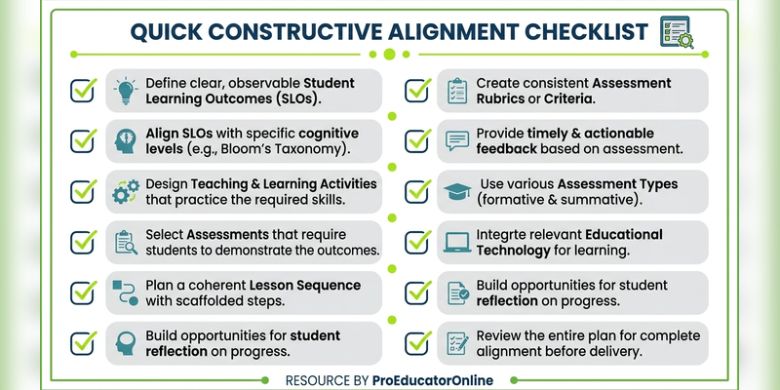
- ☐ Define clear, observable Student Learning Outcomes (SLOs).
- ☐ Align SLOs with specific cognitive levels (e.g., Bloom’s Taxonomy).
- ☐ Design Teaching & Learning Activities that practice the required skills.
- ☐ Select Assessments that require students to demonstrate the outcomes.
- ☐ Plan a coherent Lesson Sequence with scaffolded steps.
- ☐ Build opportunities for student reflection on progress.
- ☐ Create consistent Assessment Rubrics or Criteria.
- ☐ Provide timely & actionable feedback based on assessment.
- ☐ Use various Assessment Types (formative & summative).
- ☐ Integrate relevant Educational Technology for learning.
- ☐ Build opportunities for student reflection on progress.
- ☐ Review the entire plan for complete alignment before delivery.
Final Thoughts
Constructive alignment doesn’t require teachers to redesign every lesson from scratch.
Start with one lesson.
Write the learning outcome first. Identify the cognitive level. Look at the activities and ask whether students actually practice that type of thinking. Then examine the assessment and ask whether it measures the same thing.
That last check can reveal surprisingly common problems.
- A lesson that says “evaluate” shouldn’t finish with simple recall questions.
- A lesson that says “create” shouldn’t end with a multiple choice test alone.
- A lesson that says “apply” should give students a chance to use the knowledge in a meaningful situation.
Bloom’s Taxonomy helps you identify the cognitive demand. Constructive alignment helps you carry that demand consistently through the lesson.
When the SLO, learning activities, and assessment all point toward the same learning goal, students get a clearer path from learning to practice to demonstration of mastery.