

Professional Development for Teachers: Goals, Plans, Courses, and Training
Teaching doesn’t stop at graduation. A teacher can earn a degree, obtain a teaching license, and still have plenty to learn.
As we all know, everything changes with the passage of time.
For example:
- Students change with age; a teacher can observe behavioral changes among students across different levels and age groups.
- As the years pass, curriculum development authorities and educational experts update the curriculum to keep pace with new standards.
- With advances in technology and artificial intelligence in recent years, the classroom environment requires the integration of new technologies to enhance teaching.
A teacher must keep himself up to date on all of these to teach effectively and achieve better learning outcomes.
For this, professional development for teachers is essential, whether they are aspiring educators or in-service teachers.
What Is Professional Development for Teachers?
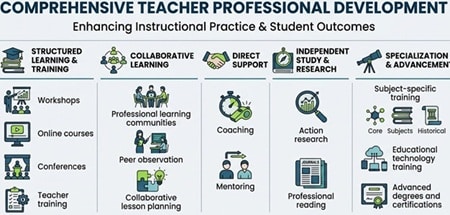
Professional development for teachers refers to ongoing learning activities that help educators improve their knowledge, teaching skills, classroom practice, and professional growth.
Professional development for teachers includes:
- Workshops
- Online courses
- Conferences
- Teacher training
- Professional learning communities
- Coaching
- Mentoring
- Peer observation
- Collaborative lesson planning
- Action research
- Professional reading
- Subject-specific training
- Educational technology training
- Advanced degrees and certifications
The format matters less than what the teacher does with the learning.
For example, attending a two-hour workshop on formative assessment provides you with information. Using exit tickets in your classroom, reviewing student responses, and adjusting your next lessons turns that information into professional learning.
Why Is Professional Development Important for Teachers?
Teachers work in a field that keeps changing. Professional learning provides educators with a structured way to respond to those changes rather than relying entirely on methods they learned years ago.
It Strengthens Teaching Skills
Professional development can help teachers improve lesson planning, questioning, assessment, classroom management, differentiation, instructional strategies, and other areas of practice.
It Helps Teachers Respond to Student Needs
A teacher may discover that students struggle with reading comprehension, mathematical reasoning, classroom discussion, writing, or independent learning.
Professional development can provide strategies that address those specific needs.
It Supports Career Growth
Professional learning can also support a teacher’s career plans.
A classroom teacher might eventually want to become:
- Grade level lead
- Department chair
- Mentor teacher
- Instructional coach
- Curriculum specialist
- School administrator
- Special education coordinator
- Professional development trainer
The skills needed for those positions don’t always develop automatically through classroom experience.
4. It Encourages Reflection
Good professional development encourages teachers to examine their own practice.
Instead of asking only, “What did I learn?” teachers should also ask:
- “What changed in my classroom?”
- “Did students respond differently?”
- “What evidence do I have?”
- “What should I change next?”
That reflection helps professional learning become an ongoing process rather than a one time event.
Professional Development vs. Professional Learning
People often use these terms interchangeably, but they can describe slightly different ideas.
Professional development often refers to organized opportunities such as courses, workshops, conferences, training, and certification programs.
Professional learning can include those activities but also covers informal and collaborative learning, such as observing a colleague, studying student work with a teaching team, experimenting with a new strategy, or reflecting on a lesson.
In practice, teachers benefit from both.
Types of Professional Development for Teachers
There isn’t one best professional development format for every teacher.
The right choice depends on your goal, experience, schedule, budget, school context, and learning preference.
Workshops and Training Sessions
Workshops provide focused learning around a particular topic.
Common examples include:
- Classroom management
- Differentiated instruction
- Literacy instruction
- Assessment
- Special education
- Educational technology
- Project based learning
- Student engagement
- Social emotional learning
- Curriculum standards
Workshops work particularly well when teachers need an introduction to a new strategy or tool.
Online Professional Development Courses
Online courses give teachers more flexibility.
Teachers can learn through:
- Self paced courses
- Live virtual workshops
- Recorded training
- Microcredentials
- Certificate programs
- Online university courses
Before enrolling, check whether the course meets your school, district, state, or licensing requirements if you need professional learning credits.
Professional Learning Communities
A professional learning community, or PLC, brings educators together to study teaching and student learning.
A PLC might examine:
- Student assessment results
- Common instructional problems
- Lesson plans
- Student work
- Intervention strategies
- Curriculum alignment
The strongest PLCs focus on evidence and classroom practice rather than simply holding another staff meeting.
Conferences
Education conferences can expose teachers to new ideas, research, classroom strategies, resources, and professional networks.
You can attend conferences focused on:
- Your subject area
- Grade level
- Special education
- Educational technology
- Leadership
- Literacy
- STEM
- Early childhood education
- Higher education
Choose sessions that connect to a specific goal rather than trying to attend everything.
Peer Observation
One of the simplest professional development activities costs nothing.
Observe another teacher.
Look specifically at something you want to improve, such as:
- Questioning
- Classroom routines
- Student discussion
- Small group instruction
- Transitions
- Assessment
- Technology use
Then discuss what you observed with the teacher.
You don’t need to copy everything the other teacher does. Identify one useful practice and adapt it to your own classroom.
Coaching and Mentoring
Instructional coaching gives teachers an opportunity to work with someone who can provide feedback and support.
Mentoring can help newer teachers develop classroom routines, planning habits, communication skills, assessment practices, and other professional skills.
Advanced Degrees and Certifications
Some teachers pursue:
- Master’s degrees
- Graduate certificates
- Subject endorsements
- Leadership certifications
- Special education certifications
- National teaching certifications
These options require more time and money, so connect them to a clear professional or career goal before enrolling.
What Are Professional Development Goals for Teachers?
A professional development goal identifies a specific area that you want to improve or develop.
A weak goal might say:
I want to become a better teacher.
That’s a positive intention, but it doesn’t tell you what to do or how to measure progress.
A stronger goal says:
Over the next eight weeks, I will use two structured discussion strategies each week and review student participation to determine which approach produces more student talk.
Now you have an action, a frequency, a timeframe, and evidence to review.
Professional development goals work best when they connect professional learning with actual classroom practice.
Examples of Professional Development Goals for Teachers
Improve Classroom Management
I will implement three consistent classroom transition routines and track transition time twice each week for six weeks.
Improve Student Engagement
I will introduce at least two structured participation strategies each week and review participation patterns at the end of each month.
Improve Formative Assessment
I will use an exit ticket at least three times each week and use the responses to plan follow up instruction.
Improve Differentiated Instruction
I will create at least one differentiated activity for each major unit and review student work to determine whether the adaptations address identified learning needs.
Improve Technology Integration
I will learn one new educational technology platform, create three classroom activities with it, and collect student feedback after each activity.
Strengthen Literacy Instruction
I will incorporate explicit vocabulary instruction into three lessons each week and monitor student use of target vocabulary during written and spoken activities.
Improve Collaboration
I will participate in two collaborative planning sessions each month and contribute at least one shared instructional resource during each session.
Develop Leadership Skills
I will lead one professional learning session for colleagues before the end of the school year and collect feedback to evaluate the session.
Improve Assessment Practices
I will review student assessment data after each major unit and document at least two instructional changes based on the results.
Prepare for a Leadership Role
I will complete a leadership course, shadow an instructional leader twice during the school year, and lead one school improvement project.
What Are SMART Goals for Teachers?
Many schools use the SMART goal framework to help teachers create clearer professional development goals.
SMART stands for:
Specific: Clearly state what you want to accomplish.
Measurable: Identify evidence that lets you track progress.
Achievable: Choose something realistic within your available time and resources.
Relevant: Connect the goal to your teaching responsibilities or career plans.
Time bound: Give the goal a deadline or defined timeframe.
For example:
General goal:
Improve student participation.
SMART goal:
By the end of the second quarter, I will use at least two structured discussion strategies each week in my Grade 7 English classes and review participation records twice each month to identify changes in student engagement.
The second goal gives you something concrete to work toward and review.
Also Read: How to Write SMART Goals
How to Create a Professional Development Plan for Teachers
A professional development plan turns a goal into an action plan.
It should answer five basic questions:
- What do I want to improve?
- Why does it matter?
- What will I do to improve?
- What support or resources do I need?
- How will I measure progress?
Step 1: Identify Your Current Need
Start with your actual teaching practice.
Ask yourself:
- Where do my students struggle?
- What part of teaching feels difficult?
- What feedback have I received?
- What does student work tell me?
- What skill would make my teaching more effective?
- What career responsibility do I want to prepare for?
Don’t choose a professional development topic simply because it sounds interesting.
Choose one that solves a real problem or supports a meaningful career goal.
Step 2: Choose One or Two Priorities
Teachers can find hundreds of professional development opportunities.
That doesn’t mean you need to take all of them.
Choose one or two priorities for a defined period.
For example:
Priority 1: Improve formative assessment.
Priority 2: Strengthen classroom discussion.
Keeping the focus narrow makes implementation more realistic.
Step 3: Write a SMART Goal
Turn the priority into a measurable goal.
Instead of:
Learn more about formative assessment.
Write:
I will complete a formative assessment course by October and use three new assessment strategies in my classroom by December.
Step 4: Choose Learning Activities
Select activities that can actually help you reach the goal.
You might:
- Take an online course
- Attend a workshop
- Read professional books
- Join a PLC
- Observe another teacher
- Work with an instructional coach
- Attend a conference
- Watch demonstration lessons
- Analyze student work
- Conduct classroom action research
Step 5: Apply the Learning
This step often gets overlooked.
Don’t stop when the training ends.
Try the strategy in your classroom.
For example, if you take training about retrieval practice, use retrieval activities during your lessons and record what happens.
Step 6: Collect Evidence
Evidence doesn’t always mean test scores.
You could collect:
- Student work
- Assessment results
- Lesson plans
- Observation notes
- Student surveys
- Participation records
- Teacher reflections
- Video recordings
- Peer feedback
Step 7: Reflect and Adjust
At the end of the goal period, ask:
- What worked?
- What didn’t?
- What changed?
- What evidence supports that conclusion?
- What should I continue?
- What should I change?
Reflection turns the professional development cycle into continuous improvement.
Teacher Professional Development Plan Template
You can use this simple template to create your own plan.
| Planning Area | Your Response |
|---|---|
| Current need | What do I want to improve? |
| Professional goal | What specific outcome do I want? |
| Why it matters | Why does this goal matter for my students, teaching, or career? |
| Learning activity | What course, workshop, coaching, reading, or collaboration will help? |
| Classroom application | What will I actually change? |
| Resources | What materials or tools do I need? |
| Support | Who can help me? |
| Timeline | When will I start and finish? |
| Evidence | What will I collect to measure progress? |
| Reflection | What did I learn and what changed? |
| Next step | What will I do after reviewing the results? |
Professional development plan examples often use similar components, including goals, objectives, activities, resources, criteria for success, and organizational support.
Professional Development Plan Example
Here’s a completed example for a middle school teacher.
| Area | Example |
| Current need | Students rarely explain their reasoning during class discussions |
| Goal | Increase student participation and quality of explanations |
| Learning activity | Complete professional learning on academic discussion strategies |
| Classroom application | Use two discussion routines every week |
| Support | Observe an experienced colleague |
| Timeline | Eight weeks |
| Evidence | Participation records and samples of student responses |
| Review | Analyze evidence every two weeks |
| Outcome | Identify which discussion strategies produce stronger student explanations |
This plan connects professional learning to a specific classroom problem.
Professional Development Activities for Teachers
Teachers don’t always need an expensive course to grow professionally.
Try these practical activities:
Read a Professional Book
Choose a book that addresses a current classroom challenge.
Don’t just read it. Select one idea and test it.
Watch Another Teacher Teach
Observe a colleague with a specific question in mind.
For example:
How does this teacher get students to begin independent work quickly?
Review Student Work
Choose several examples of student work and look for patterns.
Ask:
- What do students understand?
- Where do they struggle?
- What teaching response might help?
Record a Lesson
If your school permits recording and you follow applicable privacy requirements, review a lesson afterward.
Look at:
- Teacher talk time
- Student participation
- Questioning
- Transitions
- Wait time
- Feedback
You may notice things that feel invisible while you’re teaching.
Create a Teaching Portfolio
Keep examples of:
- Lesson plans
- Student work
- Assessments
- Professional development certificates
- Reflections
- Projects
- Classroom resources
- Leadership activities
A professional portfolio can support evaluations, interviews, promotions, and career planning.
Professional Development Ideas by Teacher Career Stage
Professional Development for Student Teachers
Focus on building basic classroom skills.
Useful areas include:
- Lesson planning
- Classroom management
- Assessment
- Differentiation
- Student communication
- Parent communication
- Educational technology
Professional Development for New Teachers
New teachers may benefit from practical support with:
- Classroom routines
- Behavior management
- Time management
- Grading
- Assessment
- Curriculum planning
- Family communication
- Special education collaboration
Professional Development for Experienced Teachers
Experienced teachers can focus on deeper instructional or leadership goals.
Examples include:
- Curriculum design
- Instructional coaching
- Assessment analysis
- Mentoring
- Action research
- Advanced subject knowledge
- Teacher leadership
Professional Development for Teacher Leaders
Teacher leaders may focus on:
- Coaching
- Adult learning
- Professional learning design
- School improvement
- Curriculum leadership
- Data analysis
- Team facilitation
- Change management
How to Choose the Right Professional Development Course
Don’t choose a course just because it offers a certificate.
Ask these questions first.
Does It Match My Goal?
If your goal involves classroom management, a course about advanced educational technology may not help much.
Can I Apply the Learning?
Look for training that includes examples, practice, planning, or opportunities to apply what you learn.
Is the Provider Credible?
Check the instructor, organization, course content, learning objectives, and reviews where available.
Does It Meet My Requirements?
If you need professional learning hours or continuing education credits, confirm that the provider and course meet your school’s, district’s, state board’s, or licensing authority’s requirements.
What Will I Actually Produce?
A useful course might leave you with:
- A lesson plan
- An assessment
- A classroom strategy
- A project
- A reflection
- A professional portfolio item
That gives you something tangible to use after the course.
Free Professional Development Ideas for Teachers
You don’t always need a large budget.
Try:
- Free webinars from education organizations
- Open educational resources
- Teacher discussion groups
- School based PLC meetings
- Peer observation
- Professional articles
- Educational podcasts
- Public lectures
- Free online workshops
- Collaborative lesson planning
- Teacher conferences with free sessions
- Professional learning communities
Your school district may also offer free professional development that counts toward required learning hours.
How to Track Professional Development
Keep a simple professional development record.
Record:
- Date
- Activity
- Provider
- Topic
- Number of hours
- Certificate or proof of completion
- Main learning points
- Classroom application
- Reflection
A spreadsheet works well for this.
You can also keep certificates in a dedicated digital folder.
Don’t wait until evaluation or license renewal time to organize everything.
Common Teacher Professional Development Mistakes
Setting Goals That Are Too Broad
“Improve teaching” doesn’t provide enough direction.
Choose a specific skill or practice.
Choosing Too Many Goals
Five major goals can quickly become overwhelming.
One or two meaningful goals may produce better results than ten unfinished ones.
Collecting Certificates Without Applying the Learning
A certificate proves that you completed an activity.
It doesn’t automatically prove that your teaching changed.
Ignoring Student Evidence
Your professional development should ultimately connect to classroom practice and student learning.
Choosing Training Because It’s Popular
A course can have thousands of participants and still not solve your particular problem.
Start with your need.
Then choose the learning opportunity.
Forgetting Reflection
After completing professional development, take time to ask what changed.
Without reflection, it’s easy to move from one course to another without building on what you’ve learned.
Professional Development Checklist for Teachers
- Use this checklist when planning your next professional development cycle.
- Identify one specific area for growth.
- Review student work, feedback, or classroom evidence.
- Write a clear professional development goal.
- Make the goal measurable and time bound.
- Choose relevant learning activities.
- Confirm professional learning or credit requirements if applicable.
- Identify the support you need.
- Create a realistic timeline.
- Apply the learning in your classroom.
- Collect evidence of progress.
- Reflect on what worked.
- Adjust your practice.
- Record your completed professional development.
- Choose your next professional learning priority.
Frequently Asked Questions
What is professional development for teachers?
Professional development for teachers includes structured and informal learning activities that help educators improve their teaching knowledge, skills, classroom practice, and career development.
What are good professional development goals for teachers?
Good goals can focus on classroom management, student engagement, assessment, differentiation, literacy, technology integration, collaboration, subject knowledge, leadership, or other areas connected to a teacher’s actual needs.
How do teachers write professional development goals?
Start with a specific area for improvement. Then define the action you will take, the evidence you will review, and the timeframe. The SMART framework can help make the goal more specific and measurable.
What is a professional development plan?
A professional development plan is a written roadmap that connects a teacher’s professional goal with learning activities, classroom application, support, timelines, and evidence of progress.
How often should teachers create professional development goals?
Many schools ask teachers to set goals annually, but teachers can review and update their goals throughout the school year. The exact requirements vary by school, district, state, or licensing system.
Can professional development include peer observation?
Yes. Peer observation can provide practical learning when teachers focus on a specific instructional practice, observe a colleague, discuss what they saw, and adapt useful strategies to their own classroom.
Does professional development have to involve a course?
No. Professional development can include courses and workshops, but teachers can also learn through coaching, mentoring, professional reading, PLCs, peer observation, collaborative planning, conferences, and classroom-based inquiry.
How can teachers make professional development more useful?
Start with a real teaching need, choose a focused goal, select relevant learning, apply the ideas in the classroom, collect evidence, and reflect on the results.
Final Thoughts
Professional development works best when teachers treat it as part of their teaching practice rather than another item on a checklist.
You don’t need to attend every conference, complete every course, or chase every new classroom tool.
Start with one real need.
Set one clear goal.
Choose learning that addresses that need.
Try the new approach.
Look at what happened.
Then decide what to keep, change, or explore next.
That simple cycle can turn professional development from a certificate-collecting exercise into meaningful professional growth.
The strongest professional development plan isn’t necessarily the longest one. It’s the one that helps a teacher make a useful change and understand whether that change actually helped.