
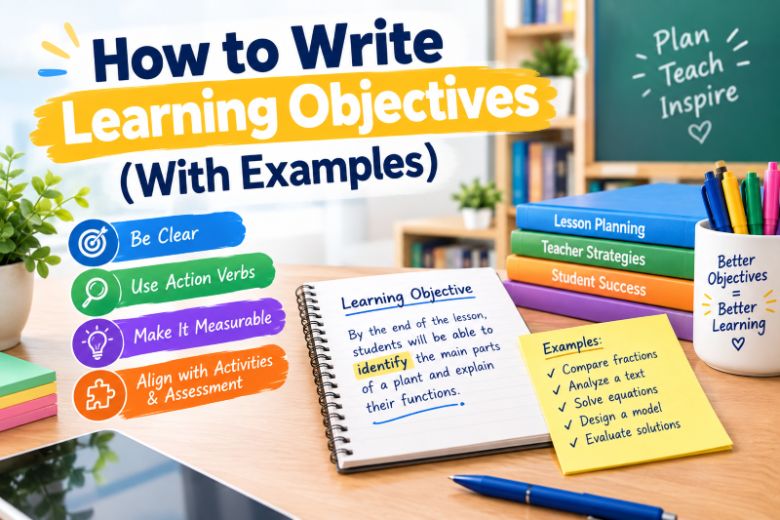
How to Write Learning Objectives: Examples for Teachers
A teacher can have an excellent lesson activity, an engaging presentation, and carefully prepared worksheets, yet the lesson can still feel unfocused if the learning objective is unclear.
One of the most common examples is:
Students will understand fractions.
The intention is clear to the teacher, but the objective does not tell us what students should actually demonstrate. Should they identify fractions, compare them, simplify them, add them, or solve real-world problems involving fractions?
A stronger objective makes the expected learning visible:
By the end of the lesson, students will compare fractions with unlike denominators using visual models and explain which fraction is greater.
Now the teacher knows what to teach, what students should practice, and what evidence to look for.
Learning objectives state what students should learn in a class, unit, or course. Cornell University’s Center for Teaching Innovation notes that learning outcomes, also called learning objectives or learning goals, help teachers decide on content, activities, and assessment.
For teachers, clearly describe what students will be able to demonstrate.
This guide focuses primarily on how to write learning objectives, with practical steps and classroom examples you can use immediately.
What Is a Learning Objective?
A learning objective is a clear statement describing what students should know, understand, or be able to do after instruction.
The important part is the student action.
Compare these two statements:
Teacher-focused
Teach students how to identify the parts of a plant.
Student-focused
Students will identify the roots, stem, leaves, flowers, and fruit of a flowering plant.
The first describes what the teacher plans to do.
The second describes what students are expected to demonstrate.
This distinction matters because learning objectives should guide the whole lesson. The objective should influence:
Objective → Learning activity → Practice → Assessment
For example:
Objective: Students will compare renewable and non-renewable energy sources.
The lesson activity might ask students to sort energy sources into categories.
The assessment might ask students to compare two energy sources and explain one advantage and limitation of each.
The pieces work together.
The University of Waterloo’s Center for Teaching Excellence similarly explains that intended learning outcomes should focus on what learners can achieve and provide a basis for selecting appropriate learning activities and assessment.
How to Write Learning Objectives
1. Start With What Students Should Be Able to Do
The most important shift is simple:
Do not begin with what you will teach. Begin with what students will demonstrate.
Compare:
Teacher will explain the causes of soil erosion.
with:
Students will explain two causes of soil erosion and describe how each cause affects soil.
The first describes the teacher’s activity.
The second describes student learning.
The University of Waterloo’s Center for Teaching Excellence recommends focusing intended learning outcomes on what learners should know, do, or value rather than on what the instructor will cover or present.
A useful starting question
Before writing the objective, ask yourself:
“At the end of this lesson, what should students be able to do that they could not do, or could not do as well, before the lesson?”
Your answer is the raw material for the objective.
Example
Suppose you are teaching the water cycle.
Your first thought might be:
I want to teach evaporation, condensation, precipitation, and collection.
That is the content.
Now ask:
What should students do with that knowledge?
Perhaps:
Explain how the four stages are connected.
Your objective becomes:
Students will explain how evaporation, condensation, precipitation, and collection are connected in the water cycle.
That is much easier to teach and assess.
2. Identify the Most Important Learning
Before choosing an action verb, decide exactly what matters most in the lesson.
Teachers often try to put everything into one objective.
For example:
Students will define, identify, explain, compare, analyze, evaluate, and create a presentation about renewable energy.
That is probably too much for one lesson.
Instead, ask:
What is essential?
Perhaps students need to distinguish renewable from non-renewable energy sources.
Then the objective could be:
Students will classify common energy sources as renewable or non-renewable and explain the reasoning behind their classification.
The University of Waterloo recommends balancing specificity with attainability. An outcome should be specific enough to assess but not so detailed that it becomes unnecessarily restrictive.
A practical teacher test
Ask:
If I had only 40 minutes, what is the most important learning students should demonstrate by the end?
That answer should guide your objective.
3. Choose an Observable Action Verb
This is one of the most important steps in writing a strong learning objective.
A learning objective needs a verb that describes something students can demonstrate.
Good examples include:
- identify
- describe
- explain
- classify
- compare
- solve
- calculate
- demonstrate
- apply
- analyze
- evaluate
- justify
- design
- create
Cornell recommends using action verbs that produce behaviors or products you can observe and measure.
Be Careful With Vague Verbs
Teachers frequently write:
- understand
- know
- learn
- appreciate
- become familiar with
- become aware of
These words describe worthwhile learning, but they do not tell you exactly what evidence you will collect.
For example:
Students will understand photosynthesis.
How will you know?
Instead, write:
Students will explain how plants use light, water, and carbon dioxide during photosynthesis.
Now you can listen to or read the explanation.
Cornell specifically recommends avoiding verbs such as “appreciate,” “become aware of,” “become familiar with,” “know,” “learn,” and “understand” when they make the expected learning difficult to observe or measure.
Important point
This does not mean that students should never understand something.
Understanding is important.
The problem is that “understand” does not tell you how students will demonstrate that understanding.
Turn it into an observable action.
For example
Instead of:
Students will understand the causes of pollution.
Write:
Students will identify three major causes of pollution and explain their effects on the environment.
4. Choose the Right Action Verb for the Learning
Do not choose a verb simply because it sounds sophisticated.
The verb should match the type of thinking you expect students to perform.
Bloom’s Taxonomy is useful here. Cornell’s teaching resource describes six commonly used cognitive levels: remembering, understanding, applying, analyzing, evaluating, and creating, with associated action verbs.
Remembering
Use this level when students need to retrieve information.
Useful verbs:
- identify
- name
- list
- define
- recall
- recognize
- label
- select
Example
Students will identify the five oceans of the world on a map.
Understanding
Use this when students need to demonstrate meaning.
Useful verbs:
- explain
- describe
- summarize
- classify
- interpret
- compare
- paraphrase
Example
Students will explain how evaporation contributes to the water cycle.
Applying
Use this when students need to use knowledge or a procedure.
Useful verbs:
- solve
- calculate
- demonstrate
- use
- apply
- perform
- construct
Example
Students will use the area formula to calculate the area of five rectangles.
Analyzing
Use this when students need to examine relationships, parts, evidence, or patterns.
Useful verbs:
- analyze
- examine
- compare
- contrast
- differentiate
- categorize
- investigate
Example
Students will analyze two characters’ decisions and explain how those decisions affect the story’s development.
Evaluating
Use this when students need to make a judgment using evidence or criteria.
Useful verbs:
- evaluate
- assess
- critique
- justify
- defend
- recommend
- judge
Example
Students will evaluate two solutions to a local environmental problem and justify which solution is more practical using evidence.
Creating
Use this when students need to produce something new.
Useful verbs:
- create
- design
- develop
- construct
- formulate
- generate
- devise
- produce
Example
Students will design a simple water filtration system using available classroom materials.
Bloom’s Taxonomy should be treated as a planning tool, not a requirement that every lesson must reach the “highest” level. The appropriate level depends on students’ prior knowledge, the content, and what you actually want them to learn. The University of Waterloo similarly notes that Bloom’s Taxonomy can help teachers determine an appropriate level of learning for their students.
5. Add the Specific Content Students Will Learn
Once you have selected the action verb, add the content.
A simple structure is:
Students will + action verb + specific content.
Examples
- Students will identify the main parts of a flower.
- Students will explain how condensation occurs.
- Students will solve two-step equations.
- Students will compare two characters in a short story.
- Students will analyze data from a plant-growth experiment.
- Students will design a simple electrical circuit.
- Notice how each objective tells us both:
What students will do
and
What they will do it with.
6. Add a Condition When It Helps Clarify the Task
Sometimes the objective needs more information about the circumstances in which students will demonstrate learning.
This is especially useful when the resources or situation matter.
You can add phrases such as:
- Given a map…
- After reading the passage…
- Using a calculator…
- Using experimental data…
- Given five examples…
- Without using a reference sheet…
- Using a provided data set…
Example
Instead of:
Students will identify the causes of climate change.
You could write:
Given a set of environmental data, students will identify three factors associated with changes in global temperature.
Or:
After reading the provided historical source, students will identify two pieces of evidence that reveal the author’s perspective.
The condition should be included when it adds useful clarity. It does not need to appear in every objective.
7. Add a Performance Standard When Appropriate
Sometimes you need to specify how well students should perform.
This is particularly useful for skills, calculations, quizzes, practical tasks, or other measurable performances.
You might specify:
- at least 4 out of 5
- with 80% accuracy
- using three pieces of evidence
- correctly identifying five examples
- completing all required steps
- with no more than one calculation error
Example
Given ten examples, students will classify at least eight as renewable or non-renewable energy sources correctly.
Or:
Students will solve at least four out of five two-step equations and show the steps used.
Or:
Students will support their argument with at least two relevant pieces of evidence from the text.
The criterion makes the expectation clearer.
However, do not add an arbitrary percentage simply because every objective appears to need one. If accuracy is not the meaningful part of the learning, another form of evidence may be more appropriate.
8. Put the Steps Together
Now we can combine the pieces.
A practical formula is:
By the end of the lesson, students will be able to + ACTION VERB + CONTENT + CONDITION, if useful + PERFORMANCE CRITERION, if useful.
Example 1
By the end of the lesson, students will be able to identify the five stages of the scientific method.
Example 2
By the end of the lesson, students will be able to explain how evaporation and condensation contribute to the water cycle using a labeled diagram.
Example 3
By the end of the lesson, students will be able to solve two-step linear equations and show the steps used to isolate the variable.
Example 4
By the end of the lesson, students will be able to analyze a short informational text and identify two claims supported by evidence.
Example 5
By the end of the lesson, students will be able to design a simple model of a water filtration system and explain the purpose of each major component.
These objectives are different because the learning is different.
Best Practices for Teachers
Make the Objective Specific, Not Complicated
Specific does not mean long.
Consider:
Students will demonstrate an understanding of the causes, consequences, historical significance, social impact, political implications, and long-term effects of the Industrial Revolution.
This sounds comprehensive.
But it is difficult to use as a practical lesson objective.
Break the learning down.
For one lesson:
Students will explain two major factors that contributed to the Industrial Revolution.
For another:
Students will analyze how industrialization changed working conditions in nineteenth-century factories.
For another:
Students will evaluate one social consequence of industrialization using evidence from historical sources.
Each objective has a clear focus.
The University of Waterloo warns against both overly generic outcomes and outcomes that are so specific that they unnecessarily restrict learning.
Make Sure the Objective Is Achievable in the Available Time
This step is easy to overlook.
Suppose you have a 45-minute lesson.
Your objective says:
Students will design, build, test, analyze, revise, and present a working bridge model.
That may be possible in a longer project, but it is probably unrealistic for one ordinary lesson unless the students have already completed some of the work.
A more realistic objective might be:
Students will design a bridge structure that meets three stated design requirements.
Then testing and revision can become objectives for later lessons.
An objective should reflect what students can reasonably accomplish given:
- lesson length
- prior knowledge
- available resources
- grade level
- complexity of the task
- support available
The University of Waterloo identifies prior knowledge, student level, and instructional context as factors teachers should consider when deciding what students can reasonably achieve.
Make Sure the Objective Matches Students’ Prior Knowledge
The same topic can require different objectives for different groups.
Consider a lesson on ecosystems.
Grade 3
Students will identify producers, consumers, and decomposers in simple food chains.
Grade 6
Students will explain how energy moves through a food chain.
Grade 8
Students will analyze how changes in one population can affect other organisms in an ecosystem.
Secondary Biology
Students will evaluate how changes in population size can alter energy flow and ecosystem stability using provided data.
The topic is related.
The expected thinking is different.
A good objective is therefore not only measurable. It is appropriate for the learners.
Check the Objective Against the Assessment
This is one of the most important steps.
After writing your objective, ask:
“How will I know that students achieved this?”
If you cannot answer that question, the objective probably needs revision.
Objective
Students will compare two characters in a short story.
Suitable assessment
Students complete a comparison chart or paragraph explaining:
- one similarity
- one difference
- evidence from the text
Objective
Students will solve two-step equations.
Suitable assessment
Students solve a set of equations and show their working.
Objective
Students will design a simple filtration system.
Suitable assessment
Students produce a design and explain how it works.
Objective
Students will evaluate the reliability of two online sources.
Suitable assessment
Students examine both sources and justify which is more reliable using stated criteria.
Cornell’s guidance on learning outcomes and assessment emphasizes that outcomes should be measurable and connected to appropriate evidence of learning.
Use the Objective to Choose the Classroom Activity
Once you write the objective, choose an activity that lets students practice the target action.
This is where objective writing becomes genuinely useful.
Objective
Students will classify animals by diet.
Appropriate activity
Students sort animal cards into herbivore, carnivore, and omnivore categories and explain their choices.
Less aligned activity
Teacher gives a 20-minute lecture about animal habitats.
The lecture may contain useful information, but students get little practice with the target action.
Objective
Students will analyze evidence from a historical source.
Appropriate activity
Students examine a source and highlight evidence supporting a particular interpretation.
Less aligned activity
Students copy definitions of historical vocabulary for the entire lesson.
The vocabulary may be useful preparation, but it does not give students enough practice with analysis.
Use “Can” to Test Your Objective
A very practical technique is to rewrite the objective as a student statement beginning with:
I can…
For example:
Teacher objective:
Students will compare renewable and non-renewable energy sources.
Student-friendly version:
I can compare renewable and non-renewable energy sources.
Another:
Teacher objective:
Students will analyze how evidence supports an author’s claim.
Student-friendly version:
I can explain how evidence supports an author’s claim.
This test helps reveal whether the objective actually describes something students can do.
If you write:
- I can understand photosynthesis.
- you immediately see the problem.
- What does “understand” mean in practice?
Instead:
I can explain how plants use light energy during photosynthesis.
Now the target is clearer.
Cornell notes that clear learning outcomes can also help students understand what they are expected to learn and take greater ownership of their progress.
Examples: Turn Weak Objectives into Strong Objectives
Example 1: Mathematics
Weak
Students will understand decimals.
Better
Students will compare decimal numbers using place value.
Stronger
Students will compare pairs of decimal numbers to the thousandths place and justify their answers using place-value reasoning.
Example 2: Science
Weak
Students will learn about the water cycle.
Better
Students will explain the stages of the water cycle.
Stronger
Students will explain how evaporation, condensation, precipitation, and collection work together in the water cycle.
Example 3: English
Weak
Students will understand the main character.
Better
Students will describe the main character’s traits.
Stronger
Students will analyze how two decisions made by the main character reveal changes in the character over the course of the story.
Example 4: Social Studies
Weak
Students will learn about democracy.
Better
Students will describe characteristics of democracy.
Stronger
Students will compare two ways citizens participate in a democratic system and explain why each form of participation matters.
Example 5: Geography
Weak
Students will understand maps.
Better
Students will identify features on a map.
Stronger
Given a physical map, students will use the legend, scale, and symbols to interpret geographic features.
Example 6: Technology
Weak
Students will learn spreadsheets.
Better
Students will use a spreadsheet to organize data.
Stronger
Students will enter a data set into a spreadsheet, calculate an average using a formula, and create a suitable chart.
Example 7: Art
Weak
Students will appreciate color.
Better
Students will identify warm and cool colors.
Stronger
Students will create an artwork using warm and cool colors to communicate contrasting moods and explain their color choices.
Example 8: Physical Education
Weak
Students will understand basketball passing.
Better
Students will demonstrate a chest pass.
Stronger
Students will demonstrate a chest pass using appropriate hand position, stepping movement, and follow-through during partner practice.
Learning Objectives for Different Grade Levels
The wording should reflect the students’ developmental level and the intended learning.
Elementary Example: Grade 2 Mathematics
Topic: Addition
Students will solve two-digit addition problems using place-value strategies.
Grade 4 Science
Topic: States of Matter
Students will classify examples of matter as solids, liquids, or gases and explain one characteristic of each state.
Grade 6 English
Topic: Main Idea
Students will identify the main idea of an informational passage and provide two supporting details.
Grade 7 Science
Topic: Ecosystems
Students will analyze how changes in one population can affect other organisms in a food web.
Grade 8 Mathematics
Topic: Linear Equations
Students will solve two-step linear equations and verify their solutions by substitution.
Secondary English
Topic: Argument
Students will evaluate an author’s argument by analyzing the claim, evidence, and reasoning presented in an informational text.
The important point is not to make secondary objectives sound more complicated. The objective should accurately represent the level of thinking required.
How to Write Objectives for Practical Skills
Not all learning is about remembering or explaining information.
Some subjects require students to perform.
Examples include:
- laboratory work
- physical education
- art
- music
- vocational education
- technology
- engineering
- practical science
For these objectives, focus on the observable performance.
Science Laboratory
Instead of:
Students will understand laboratory safety.
Write:
Students will demonstrate correct laboratory safety procedures when setting up and conducting the experiment.
Art
Instead of:
Students will learn shading.
Write:
Students will use gradual changes in value to create the appearance of depth in a drawing.
Computer Science
Instead of:
Students will understand programming loops.
Write:
Students will write a program that uses a loop to repeat a specified operation.
Physical Education
Instead of:
Students will learn volleyball serving.
Write:
Students will demonstrate an overhand serve using the correct preparation, contact, and follow-through.
The University of Waterloo notes that learning can involve cognitive, psychomotor, and affective domains, so objectives should not be limited to academic recall or written responses.
How to Write Objectives for Higher-Order Thinking
Not every objective needs to stop at identifying or describing.
When students have sufficient background knowledge, you can ask them to work with evidence, relationships, problems, or competing ideas.
Compare
Students will compare two approaches to solving the problem and identify one advantage of each.
Analyze
Students will analyze experimental data to determine whether the hypothesis was supported.
Evaluate
Students will evaluate two proposed solutions using three stated criteria.
Justify
Students will justify their conclusion using at least two pieces of evidence.
Design
Students will design a solution that addresses the stated engineering constraints.
Cornell’s assessment guidance connects different levels of learning with suitable tasks such as case studies, critiques, problem sets, projects, and design tasks.
Use a Simple Objective-Writing Formula
When you are short on time, use this:
Students will + VERB + WHAT THEY WILL LEARN.
Examples
- Students will identify the parts of a flower.
- Students will explain how rainfall occurs.
- Students will compare fractions.
- Students will solve two-step equations.
- Students will analyze a historical source.
- Students will evaluate an argument.
- Students will design a simple bridge.
Then strengthen the objective when necessary by adding a condition or criterion.
Stronger version
Given a historical photograph, students will analyze two visual details and explain what each detail suggests about the period.
Stronger mathematics example
Students will solve five two-step equations and show the steps used to reach each solution.
A Ready-to-Use Learning Objective Template
Teachers can copy this template directly into a lesson plan:
Learning Objective:
By the end of the lesson, students will be able to [action verb] [specific knowledge or skill] [condition/context, if needed] [performance criterion, if needed].
Example
By the end of the lesson, students will be able to analyze a short informational text and identify two claims supported by relevant evidence.
Mathematics
By the end of the lesson, students will be able to solve two-step equations and show the steps used to isolate the variable.
Science
By the end of the lesson, students will be able to explain how evaporation and condensation contribute to the water cycle using a labeled diagram.
Social Studies
By the end of the lesson, students will be able to compare two forms of citizen participation and explain one advantage of each.
STEM
By the end of the lesson, students will be able to design a structure that meets three stated engineering constraints and explain how their design addresses each constraint.
Quick Reference: Action Verbs Teachers Can Use
| Learning focus | Useful action verbs |
| Remember | identify, define, list, name, recall, label |
| Understand | explain, describe, summarize, classify, interpret |
| Apply | solve, calculate, use, demonstrate, implement |
| Analyze | analyze, compare, contrast, examine, categorize |
| Evaluate | evaluate, justify, critique, defend, assess |
| Create | design, create, develop, construct, formulate |
These categories are based on the revised Bloom’s Taxonomy commonly used in instructional planning. Cornell provides a more extensive list of action verbs and explains their relationship to different levels of learning.
Conclusion
Writing a learning objective should not be an exercise in finding impressive educational language.
It is a planning decision.
The strongest objectives tell you what students should demonstrate, not simply what topic the teacher intends to cover.
When writing your next objective, use proper sequence:
The objective should act as the thread connecting what you teach, what students practice, and what you assess. When those three pieces point in the same direction, lesson planning becomes much more purposeful and easier to evaluate.