
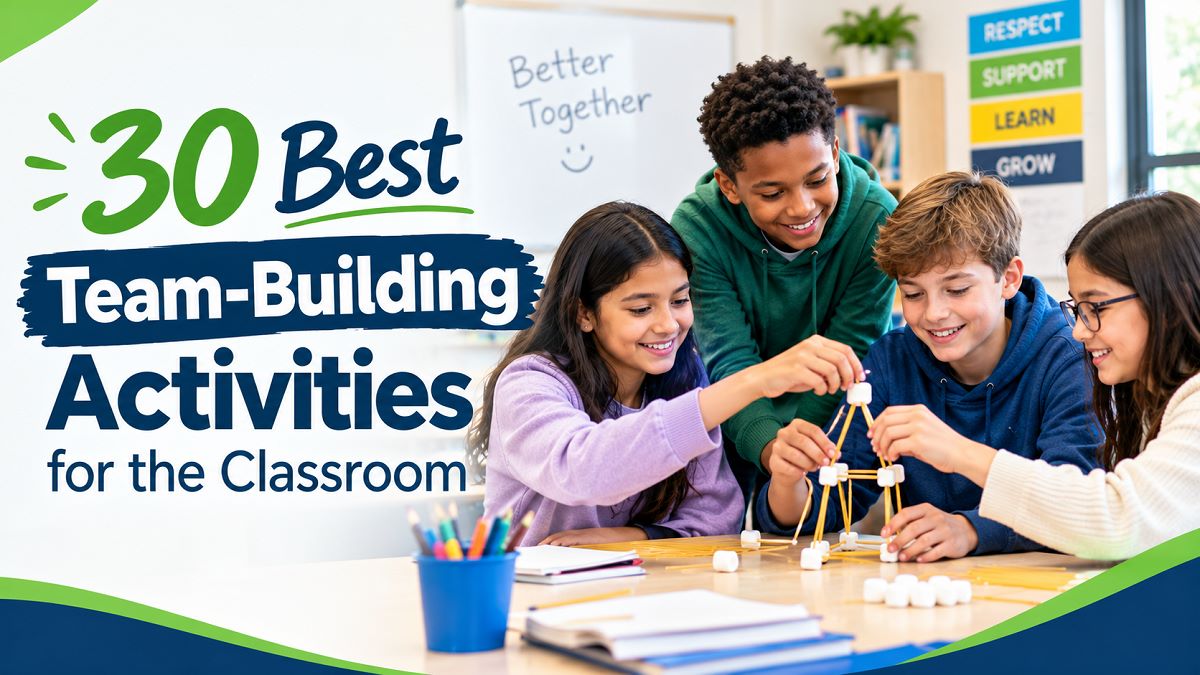
30 Team Building Activities for the Classroom (All Grades)
A classroom can have 30 students sitting in the same room without feeling like a team. Some students work comfortably with their friends, others hesitate to speak, and a few may find group tasks frustrating because they feel their contributions are overlooked. Teachers often notice these differences when students are asked to complete collaborative assignments or solve problems together.
Team-building activities can help change that dynamic. They give students structured opportunities to communicate, share ideas, solve problems, make decisions, and recognize one another’s strengths. Instead of simply telling students to cooperate, teachers create situations in which cooperation becomes necessary.
The best classroom team-building activities do not require expensive equipment, complicated preparation, or an entire lesson period. A paper tower, a shared story, a problem-solving challenge, or a simple partner interview can give students an opportunity to practice working together.
This guide presents 30 team building activities for elementary, middle, and high school classrooms. Each activity includes instructions, suggested timing, materials, and practical teaching tips. You will also find quick activities, no-preparation options, strategies for including different learners, and a sample five-day classroom team-building plan.
What Are Team-Building Activities in the Classroom?
Team-building activities are structured games, challenges, and collaborative tasks that help students develop positive working relationships. They encourage learners to communicate, listen, share responsibilities, solve problems, and work toward a common goal.
Unlike activities in which students compete only for individual rewards, classroom team-building tasks emphasize shared participation and collective progress.
For example, a teacher might ask groups of four students to build the tallest freestanding paper tower. One student may suggest a design, another may fold the paper, a third may test its stability, and the fourth may record the results. The group succeeds when its members combine their ideas and improve the structure together.
These activities can be used:
- At the beginning of a school year to help students become familiar with one another.
- After a school break to rebuild classroom connections.
- Before starting a group project or collaborative assignment.
- When students need practice with communication and shared decision-making.
- During morning meetings, advisory periods, or classroom transitions.
- Throughout the year to strengthen a positive classroom environment.
An important distinction: Team building is not simply putting students into groups. A meaningful activity gives every learner a reason to participate and helps the class practice a specific behavior, such as listening, encouraging others, or sharing responsibility.
Why Are Team-Building Activities Important for Students?
A classroom team is not formed through one successful game. It develops through repeated opportunities to work with different classmates, respect different viewpoints, and contribute to shared goals.
Well-designed activities can support several important areas of student development.
Improve Communication Skills
Students practice expressing ideas, asking questions, explaining instructions, and listening to others.
For example, during a drawing challenge, one student describes an image while a partner attempts to recreate it without seeing the original. The task requires clear explanations and careful listening.
Encourage Cooperation
Some classroom challenges cannot be completed successfully by one student working alone. Students must exchange ideas, divide responsibilities, and support one another.
This creates opportunities to practice cooperation rather than simply discussing its importance.
Build Positive Peer Relationships
Students often interact with familiar friends during ordinary classroom routines. Structured team activities can introduce new partnerships and help learners discover shared interests or abilities.
The Australian Education Research Organisation highlights positive peer relationships and opportunities for interaction as important elements of school belonging.
Develop Problem-Solving Skills
Team challenges encourage students to examine a problem, suggest possible solutions, test ideas, and revise their approach.
For example, a group building a paper bridge may discover that its first design collapses. Students can discuss why it failed and try a different structure.
Support Confidence and Participation
Some learners are comfortable speaking in front of the class, while others prefer smaller discussions or written contributions.
A carefully structured activity offers different ways to participate. Students can contribute through drawing, organizing, recording, building, explaining, or asking questions.
Develop Leadership and Shared Responsibility
Team-building activities give students opportunities to take responsibility for different tasks. Leadership can involve organizing materials, inviting quieter classmates to contribute, managing time, or summarizing the group’s decisions.
It should not always belong to the most outspoken student.
Research supports the educational value of structured cooperation. A 2026 second-order meta-analysis of cooperative-learning research reported a moderate positive effect on learning outcomes, including academic achievement, higher-order thinking, and affective behaviors. This does not mean every classroom game automatically improves achievement. The quality of the group task and the way it is organized matter.
30 Best Team-Building Activities for the Classroom
The following activities are organized around practical classroom needs. Some take only five minutes, while others work well as longer collaborative challenges.
Quick Comparison: Choose an Activity for Your Class
| Activity | Time | Materials | Suitable for |
|---|---|---|---|
| 1. Find Three Things in Common | 10 min | None | All grades |
| 2. Name and Motion Circle | 5–10 min | None | Elementary |
| 3. Classroom Bingo | 10–15 min | Bingo sheet | All grades |
| 4. One-Word Story | 10 min | None | Elementary, middle |
| 5. Silent Line-Up | 5–10 min | None | All grades |
| 6. Paper Tower Challenge | 15–20 min | Paper, tape | All grades |
| 7. Marshmallow Tower | 15–20 min | Spaghetti, marshmallow | Middle, high |
| 8. The Human Knot | 10–15 min | Open space | Middle, high |
| 9. Group Drawing Challenge | 10–15 min | Paper, pencils | All grades |
| 10. Mystery Object Challenge | 15 min | Classroom objects | All grades |
| 11. Pass the Hoop | 5–10 min | Hula hoop | Elementary, middle |
| 12. Team Puzzle Race | 15 min | Puzzles | All grades |
| 13. Blind Drawing | 10–15 min | Paper, pencils | All grades |
| 14. Build a Bridge | 20 min | Paper, books, tape | All grades |
| 15. The Survival Ranking Game | 20 min | Scenario sheet | Middle, high |
| 16. Classroom Scavenger Hunt | 15–20 min | Clue cards | All grades |
| 17. Compliment Circle | 5–10 min | None | All grades |
| 18. Team Quiz Challenge | 15–20 min | Questions, board | All grades |
| 19. Shared Goal Challenge | 10–15 min | Chart paper | All grades |
| 20. Design a Dream Classroom | 20–30 min | Paper, markers | All grades |
| 21. Problem-Solving Cards | 10–15 min | Scenario cards | Middle, high |
| 22. The Common Drawing | 15 min | Large paper | All grades |
| 23. Paper Chain Challenge | 10–15 min | Paper, tape | Elementary, middle |
| 24. Community Quilt | 20–30 min | Paper, colors | All grades |
| 25. The Mystery Leader | 10 min | None | Elementary, middle |
| 26. Team Charades | 10–15 min | Word cards | All grades |
| 27. Classroom Debate Teams | 15–20 min | Topic cards | Middle, high |
| 28. The Lost Island Challenge | 20 min | Scenario cards | Middle, high |
| 29. Teach Your Team | 15–20 min | Subject materials | All grades |
| 30. The Class Achievement Wall | 15–20 min | Chart paper | All grades |
Times are approximate and should be adjusted for class size, age, and available space.
Activities 1–10: Easy Team-Building Games for Everyday Classroom Use
1. Find Three Things in Common
Time: 10 minutes
Materials: None
Best for: Elementary, middle, and high school
This activity helps students discover shared interests beyond their usual friendship groups.
How to play:
- Divide students into groups of three or four.
- Ask each group to find three things all members have in common.
- Encourage students to move beyond obvious answers such as being in the same class.
- Give groups five minutes to discuss.
- Invite each group to share one interesting discovery.
Possible answers include enjoying a particular sport, liking the same type of music, or preferring a certain subject.
Teacher tip: Make personal questions optional. Students should not have to reveal private family information or experiences to participate.
2. Name and Motion Circle
Time: 5–10 minutes
Materials: None
Best for: Younger elementary students
This is a simple way to help students remember classmates’ names.
How to play:
- Ask students to stand or sit in a circle.
- The first student says their name and makes a simple movement.
- The class repeats the name and movement.
- Continue around the circle.
- At the end, invite volunteers to recall the names and movements.
Students can choose small movements such as waving, clapping, or raising one hand.
Teacher tip: Offer the option to say a name without making a movement. This keeps participation comfortable for students with different physical abilities or confidence levels.
3. Classroom Bingo
Time: 10–15 minutes
Materials: Bingo sheets and pencils
Best for: All grades
Create a bingo sheet containing statements such as:
- Enjoys reading stories.
- Likes solving puzzles.
- Plays a musical instrument.
- Enjoys science experiments.
- Likes drawing.
- Has visited another city.
How to play:
- Give each student a bingo sheet.
- Students move around the classroom and find classmates who match each statement.
- Ask them to write the classmate’s name in the corresponding box.
- Encourage students to speak with several classmates.
- Discuss some of the discoveries afterward.
Teacher tip: Do not make students disclose sensitive personal details. Use interests, learning preferences, and harmless classroom experiences.
4. One-Word Story
Time: 10 minutes
Materials: None
Best for: Elementary and middle school
Students create a shared story by contributing one word at a time.
How to play:
- Divide students into groups of five or six.
- Give each group a simple opening, such as “One morning, our class discovered…”
- The first student adds one word.
- Each student adds another word in sequence.
- Continue until the group has created a complete story.
- Ask a volunteer to read it aloud.
The activity requires students to listen carefully and build on another person’s contribution.
Teacher tip: For older students, ask groups to include a particular theme, vocabulary word, or grammar structure.
5. Silent Line-Up
Time: 5–10 minutes
Materials: Open classroom space
Best for: All grades
Students arrange themselves in a particular order without speaking.
How to play:
- Ask students to line up according to their birth month.
- Explain that speaking is not allowed.
- Students use gestures and other agreed communication methods.
- Once they believe the line is correct, invite them to check the order.
- Discuss how they communicated without words.
Other versions include arranging students by the first letter of their names or by the number of letters in their names.
Teacher tip: Provide a seated or card-based version for students who cannot easily move around the room. Avoid requiring students to reveal their exact birth dates.
6. Paper Tower Challenge
Time: 15–20 minutes
Materials: Newspaper or ordinary paper and tape
Best for: All grades
This activity turns teamwork into a simple engineering challenge.
How to play:
- Divide the class into teams of three or four.
- Give each group the same amount of paper and tape.
- Challenge students to build the tallest freestanding tower.
- Set a 10-minute construction period.
- Measure the towers and discuss which designs remained stable.
Teacher tip: Ask students to sketch a design before building. This gives everyone an opportunity to contribute ideas before the construction begins.
7. Marshmallow Tower Challenge
Time: 15–20 minutes
Materials: Dry spaghetti, tape, string, and marshmallows
Best for: Middle and high school
Students work together to build a freestanding structure using limited materials.
How to play:
- Give each team an identical set of materials.
- Explain that the structure must stand independently.
- Allow teams to plan before construction begins.
- Set a fixed building period.
- Test the structures and discuss which designs worked best.
Teacher tip: Make the challenge about testing and improving ideas rather than simply winning. Check food allergies and use a non-food alternative where needed. Do not allow students to eat materials used in the activity.
8. The Human Knot
Time: 10–15 minutes
Materials: Open space
Best for: Middle and high school
Students practice communication while working together to untangle a group formation.
How to play:
- Ask five or six willing students to stand in a circle.
- Each student reaches across and holds hands with two different people.
- The group works together to untangle itself without releasing hands.
- Students must communicate and coordinate their movements.
- Discuss which instructions and strategies helped.
Teacher tip: This activity involves physical contact and movement. Offer a no-contact alternative, such as an untangling puzzle using ropes on a table. Never force participation.
9. Group Drawing Challenge
Time: 10–15 minutes
Materials: Paper and colored pencils
Best for: All grades
Students work together to create one drawing.
How to play:
- Give each group a topic such as “A school of the future.”
- The first student draws one part of the picture.
- Pass the paper to the next student.
- Each student adds something that connects to the existing drawing.
- Continue until the group has completed its picture.
- Ask groups to explain how they combined their ideas.
Teacher tip: Give students a planning minute before drawing. Encourage them to discuss the purpose of the picture rather than adding unrelated details.
10. Mystery Object Challenge
Time: 15 minutes
Materials: Everyday classroom objects
Best for: All grades
Give each group an ordinary object and ask students to invent a new use for it.
How to play:
- Place objects such as paper clips, cardboard tubes, rulers, and empty boxes on a table.
- Give each group one object.
- Ask students to brainstorm an unusual but practical use.
- Let groups create a short explanation or sketch.
- Invite groups to present their ideas.
For example, a cardboard tube could become a model tunnel, a pencil holder, or part of a miniature playground.
Teacher tip: Reward creative thinking, clear explanations, and collaboration rather than selecting only the most unusual idea.
Activities 11–20: Cooperative Challenges That Strengthen Teamwork
11. Pass the Hoop
Time: 5–10 minutes
Materials: One hula hoop
Best for: Elementary and middle school
How to play:
- Students form a circle and hold hands if comfortable.
- Place a hula hoop over the arm of one student.
- Students work together to pass the hoop around the circle without breaking the connection.
- Repeat and ask students to improve their coordination.
For a no-contact version, students can pass a soft object around a circle using a specified method.
Learning focus: Cooperation, coordination, and patience.
12. Team Puzzle Race
Time: 15 minutes
Materials: Identical puzzles or sets of picture pieces
Best for: All grades
How to play:
- Divide students into small teams.
- Give each team an identical puzzle.
- Ask students to divide tasks, such as sorting edge pieces or identifying colors.
- Set a time limit.
- Ask each group to explain how it organized its work.
Teacher tip: Focus on how teams organized their work rather than only on speed. A cooperative challenge should not embarrass students who work at a different pace.
13. Blind Drawing
Time: 10–15 minutes
Materials: Paper and pencils
Best for: All grades
One student describes an image while another draws it without seeing the original.
How to play:
- Prepare a simple picture.
- Pair students.
- Give one student the picture and the other a blank sheet.
- The student with the picture describes the image without naming it.
- The partner draws according to the instructions.
- Compare the drawing with the original and discuss communication.
Teacher tip: Allow partners to ask clarifying questions. The goal is clear communication, not perfect artwork.
14. Build a Bridge
Time: 20 minutes
Materials: Paper, tape, and two books
Best for: Elementary, middle, and high school
Students design a bridge that can span a small gap.
How to play:
- Place two books a short distance apart.
- Give each team an equal amount of paper and tape.
- Challenge students to build a bridge between the books.
- Test the bridge using small classroom objects as weights.
- Ask teams to explain their design decisions.
Teacher tip: Ask students to make one improvement after the first test. This turns the task into a simple engineering process involving planning, testing, and revision.
15. The Survival Ranking Game
Time: 20 minutes
Materials: Scenario sheet and pencils
Best for: Middle and high school
Present students with a fictional situation, such as being stranded on a remote island with ten available items.
How to play:
- Give each student a list of ten objects.
- Ask students to rank the objects individually.
- Put students into small teams.
- Ask each team to agree on one shared ranking.
- Invite teams to explain the reasons behind their decisions.
Possible objects include a rope, water container, compass, first-aid kit, flashlight, and blanket.
Teacher tip: The value of this activity is in the discussion. Do not focus on finding one supposedly perfect answer. Ask students how they reached agreement and handled different opinions.
16. Classroom Scavenger Hunt
Time: 15–20 minutes
Materials: Clue cards
Best for: Elementary and middle school
Create a hunt around classroom resources and learning materials.
How to play:
- Prepare clues about classroom objects, books, displays, or learning areas.
- Divide students into teams.
- Give each group the first clue.
- Students solve the clues together.
- Finish with a final question or short reflection.
Teacher tip: Make sure students walk rather than run. Do not place clues near restricted equipment, personal belongings, or unsafe areas.
17. Compliment Circle
Time: 5–10 minutes
Materials: None
Best for: All grades
Students recognize positive contributions made by their classmates.
How to play:
- Arrange students in a circle or seated groups.
- Invite each student to recognize a helpful action or positive contribution.
- Encourage specific comments such as “You explained the instructions clearly.”
- Allow students to pass if they do not wish to speak.
- Close by discussing why respectful recognition matters.
Teacher tip: Focus on genuine actions rather than appearance, popularity, or comparisons. Written appreciation cards can be an alternative for students who prefer not to speak.
18. Team Quiz Challenge
Time: 15–20 minutes
Materials: Questions and a board
Best for: All grades
Turn a subject review into a collaborative activity.
How to play:
- Divide students into balanced teams.
- Display one question at a time.
- Give teams time to discuss possible answers.
- Rotate the student responsible for recording the answer.
- Award points for correct answers and clear explanations.
Teacher tip: Rotate participation so one confident student does not answer every question. Ask different students to explain the reasoning behind an answer.
19. Shared Goal Challenge
Time: 10–15 minutes
Materials: Chart paper and markers
Best for: All grades
Students identify a realistic goal they can work toward as a class.
How to play:
- Ask students what would make their classroom a better place to learn.
- Collect suggestions.
- Group similar ideas.
- Agree on one achievable class goal.
- Decide how the class will measure progress.
Examples include making sure everyone has an opportunity to speak, keeping shared materials organized, or helping classmates during collaborative tasks.
Teacher tip: Keep the goal observable and manageable. Revisit it after one or two weeks.
20. Design a Dream Classroom
Time: 20–30 minutes
Materials: Paper, markers, and rulers
Best for: All grades
Groups design a classroom that supports learning, participation, and cooperation.
How to play:
- Divide students into teams.
- Ask each group to sketch its ideal classroom.
- Require students to include learning areas, seating arrangements, and shared resources.
- Ask them to explain how their design supports different learners.
- Display the designs and compare ideas.
Teacher tip: Connect the activity to real classroom needs. Ask students how their designs would help classmates who need quiet spaces, accessible movement, or opportunities for group work.
Activities 21–30: Creative and Challenging Team-Building Activities
21. Problem-Solving Cards
Time: 10–15 minutes
Materials: Scenario cards
Best for: Middle and high school
Prepare short classroom situations that require a group decision.
Examples:
- Your group has only ten minutes to complete a project. How will you divide the work?
- Two students suggest different solutions. How can the group evaluate both?
- One group member has not had an opportunity to contribute. What can the team do?
How to play:
- Give each group one scenario.
- Ask students to identify the problem.
- Give them time to suggest possible responses.
- Ask them to agree on a practical solution.
- Invite groups to explain their decisions.
Teacher tip: Use fictional situations rather than asking students to discuss a real classmate’s conflict publicly.
22. The Common Drawing
Time: 15 minutes
Materials: Large sheet of paper and markers
Best for: All grades
Each group creates a picture in which every member must contribute.
How to play:
- Give groups one large sheet of paper.
- Set a theme such as “Our learning community.”
- Ask each student to add one element.
- Students discuss how the different elements connect.
- Groups explain the meaning of their final picture.
Teacher tip: Invite students to describe the contribution they made and one idea they borrowed from a teammate.
23. Paper Chain Challenge
Time: 10–15 minutes
Materials: Paper strips, tape, or glue
Best for: Elementary and middle school
Teams create the longest paper chain using a limited amount of paper.
How to play:
- Divide students into groups.
- Give every group the same number and size of paper strips.
- Explain that each strip must become part of the chain.
- Set a 10-minute limit.
- Compare the results and discuss how teams divided responsibilities.
Teacher tip: Add a second round in which teams improve their method. Ask what they changed and why.
24. Community Quilt
Time: 20–30 minutes
Materials: Paper squares, colored pencils, and tape
Best for: All grades
Each student creates one square representing a positive classroom value.
How to play:
- Give every student a paper square.
- Ask them to draw or write a word representing a positive learning community.
- Collect the squares.
- Arrange them into one large classroom display.
- Discuss how individual contributions create a shared community.
Possible words include respect, kindness, curiosity, patience, creativity, and cooperation.
Teacher tip: Make participation flexible. Students can draw, write, use symbols, or dictate their ideas.
25. The Mystery Leader
Time: 10 minutes
Materials: None
Best for: Elementary and middle school
One student leads a sequence of simple movements while the rest of the group tries to identify the leader.
How to play:
- Ask one student to leave the room briefly or turn away.
- Choose a leader from the remaining group.
- The leader begins a simple movement, such as tapping a knee or clapping.
- Other students copy the movement.
- The student returns and observes the group to identify the leader.
Teacher tip: Keep movements simple and comfortable. The focus is observation, participation, and shared attention.
26. Team Charades
Time: 10–15 minutes
Materials: Word or phrase cards
Best for: All grades
Students communicate ideas through gestures rather than speech.
How to play:
- Prepare cards with topics related to classroom learning or familiar objects.
- Divide students into teams.
- One student acts out the card without speaking.
- Teammates discuss and guess the answer.
- Rotate the performer so different students participate.
Teacher tip: Use vocabulary from a current subject unit to make the activity educational as well as social.
27. Classroom Debate Teams
Time: 15–20 minutes
Materials: Topic cards
Best for: Middle and high school
Students work together to develop and explain an argument.
How to play:
- Present a suitable question, such as “Should schools have a daily reading period?”
- Divide the class into groups representing different viewpoints.
- Ask each group to develop three supporting reasons.
- Give students time to organize their responses.
- Invite groups to present and respond respectfully.
Teacher tip: Explain that disagreement is acceptable, but personal attacks are not. Reward evidence, respectful listening, and clear reasoning.
28. The Lost Island Challenge
Time: 20 minutes
Materials: Scenario and object cards
Best for: Middle and high school
Students imagine they must work together to solve a fictional survival challenge.
How to play:
- Present a scenario in which a group must organize resources after arriving on a fictional island.
- Give teams a list of available items.
- Ask them to select the five most useful items.
- Require students to explain how each selection supports their plan.
- Ask teams to present their decisions.
Teacher tip: Make the activity fictional and focused on decision-making. Avoid presenting it as actual emergency survival guidance.
29. Teach Your Team
Time: 15–20 minutes
Materials: Subject notes or learning resources
Best for: All grades
Each student becomes responsible for explaining a small part of a topic to teammates.
How to play:
- Divide a lesson topic into several small sections.
- Assign each student one section to study.
- Give students time to prepare a short explanation.
- Ask them to teach their section to their group.
- Give the team a final task requiring knowledge from every section.
For example, in a science lesson, students might explain different parts of a plant or stages of the water cycle.
Teacher tip: Check individual understanding after the activity. Group success should not hide gaps in one student’s learning.
30. The Class Achievement Wall
Time: 15–20 minutes
Materials: Chart paper and sticky notes
Best for: All grades
Create a display recognizing positive teamwork and shared progress.
How to play:
- Place a large sheet of paper on a classroom wall.
- Give students sticky notes.
- Ask each student to record one helpful action they noticed during a group activity.
- Add the notes to the display.
- Review the contributions at the end of the week.
Examples include sharing materials, listening carefully, explaining a difficult idea, and inviting another student to contribute.
Teacher tip: Recognize specific behaviors rather than ranking students or creating a popularity contest.
Best Team-Building Activities by Grade Level
The same activity may need different instructions depending on students’ age, confidence, and development.
Elementary School
Younger students often benefit from short, concrete activities with clear instructions and visible outcomes.
Recommended activities:
- Name and Motion Circle
- Classroom Bingo
- One-Word Story
- Paper Tower Challenge
- Group Drawing Challenge
- Pass the Hoop
- Team Puzzle Race
- Mystery Leader
- Paper Chain Challenge
- Community Quilt
Classroom example: A Grade 3 teacher can begin a unit with Classroom Bingo. Students discover shared interests, speak with classmates they do not usually work with, and finish by sharing one new thing they learned about another student.
Middle School
Middle school students can benefit from activities that involve decision-making, creative problem-solving, and shared responsibility.
Recommended activities:
- Find Three Things in Common
- Silent Line-Up
- Human Knot
- Mystery Object Challenge
- Blind Drawing
- Survival Ranking Game
- Problem-Solving Cards
- Team Quiz Challenge
- The Lost Island Challenge
- Teach Your Team
Classroom example: A Grade 7 teacher can use the Paper Tower Challenge before a science unit on structures. Students plan, build, test, and discuss why some designs are more stable than others.
High School
Older students often respond well to tasks involving discussion, debate, realistic problems, and independent contributions.
Recommended activities:
- Find Three Things in Common
- Marshmallow Tower Challenge
- Survival Ranking Game
- Blind Drawing
- Problem-Solving Cards
- Design a Dream Classroom
- Classroom Debate Teams
- The Lost Island Challenge
- Teach Your Team
- Shared Goal Challenge
Classroom example: A Grade 10 teacher can use the Survival Ranking Game during an advisory period. Students first rank resources individually, then develop a shared ranking as a group. The teacher assesses how they support claims, consider alternatives, and reach agreement.
5 No-Preparation Team-Building Activities for Busy Teachers
Sometimes a teacher has only five or ten minutes available. These activities require little or no preparation.
| Activity | How it works | Time |
|---|---|---|
| Three Things in Common | Groups discover three shared interests. | 5–10 min |
| One-Word Story | Students create a story one word at a time. | 5–10 min |
| Silent Line-Up | Students arrange themselves without speaking. | 5 min |
| Compliment Circle | Students recognize helpful actions. | 5 min |
| Shared Goal | The class agrees on one achievable goal. | 5–10 min |
A practical suggestion: Keep a short list of these activities in your lesson-planning notebook. They can be useful during unexpected schedule changes, after a difficult classroom interaction, or when students need a short reset before beginning a collaborative task.
How to Organize Effective Team-Building Activities
Even a simple game needs a little structure. Without clear expectations, some students may dominate the discussion while others remain passive.
Use the following steps to make activities more purposeful.
Step 1: Decide What Students Should Practice
Choose one main purpose before selecting an activity.
For example:
- Communication: Blind Drawing.
- Listening: One-Word Story.
- Shared decision-making: Survival Ranking Game.
- Cooperation: Paper Tower Challenge.
- Respect and appreciation: Compliment Circle.
- Problem-solving: Build a Bridge.
A clear purpose makes it easier to select the right activity and evaluate its value.
Step 2: Form Balanced Groups
Use pairs, groups of three, or groups of four depending on the task.
Avoid placing students into permanent friendship groups for every activity. Changing partnerships gives students opportunities to interact with different classmates.
However, do not force students into combinations that create known safety or relationship concerns. Use your professional judgment when forming groups.
Step 3: Explain the Rules Clearly
Before starting:
- Explain the goal.
- Show the materials.
- Demonstrate the task if necessary.
- Explain the time limit.
- Clarify safety and participation expectations.
- Check that students understand what they need to do.
Step 4: Give Every Student a Role
For larger challenges, assign simple roles:
- Coordinator: Helps the group stay focused.
- Materials manager: Organizes the supplies.
- Recorder: Writes down ideas and decisions.
- Reporter: Shares the team’s result.
- Encourager: Makes sure members have opportunities to contribute.
Rotate roles in future activities so that students experience different responsibilities.
Step 5: Observe How Students Work Together
Do not focus only on the final product. Notice the behaviors that helped or prevented cooperation.
Ask yourself:
- Did students listen to one another?
- Did everyone have a meaningful contribution?
- Did the group share responsibilities?
- How did students respond to different opinions?
- Did they change their approach when something failed?
Step 6: End With a Short Reflection
A short discussion helps students connect the activity with everyday classroom behavior.
Ask:
- What helped your group work successfully?
- Was every member able to contribute?
- What would you change next time?
- How can you use this teamwork skill during a normal lesson?
This final discussion is often more valuable than announcing which group finished first.
How to Include Every Student in Team-Building Activities
A classroom activity should create opportunities for participation, not pressure students into uncomfortable situations.
Consider these practical adjustments.
Support Shy or Reluctant Students
- Begin with pairs before moving to larger groups.
- Give students time to think before sharing.
- Allow written responses as an alternative to speaking.
- Avoid forcing students to perform in front of the whole class.
- Assign meaningful roles that do not always require public speaking.
Support Students With Different Learning Needs
- Provide written and spoken instructions.
- Break complex tasks into smaller steps.
- Use pictures, diagrams, or demonstrations.
- Offer seated and movement-based alternatives.
- Provide extra processing time where needed.
- Allow students to demonstrate ideas through drawing, speaking, writing, or building.
Support Multilingual Learners
- Use simple instructions and visual examples.
- Provide important vocabulary before the activity.
- Allow students to discuss ideas using their strongest language when appropriate.
- Pair students thoughtfully.
- Give sentence starters such as “I agree because…” and “Another idea could be…”
Prevent One Student From Doing All the Work
- Rotate group roles.
- Ask every member to contribute one idea.
- Include individual reflection after group tasks.
- Invite different students to explain the team’s decisions.
- Assess both the shared result and individual understanding.
Remember: Inclusion does not mean every student must participate in exactly the same way. It means each student has a meaningful and appropriate way to contribute.
A Five-Day Classroom Team-Building Plan
Teachers who want to establish stronger classroom connections can spread activities across a week rather than trying to achieve everything in one lesson.
| Day | Activity | Main purpose | Reflection question |
|---|---|---|---|
| Monday | Find Three Things in Common | Build connections | What did you discover about a classmate? |
| Tuesday | Silent Line-Up | Communication | How did you communicate without speaking? |
| Wednesday | Paper Tower Challenge | Cooperation | How did your team improve its design? |
| Thursday | Problem-Solving Cards | Decision-making | How did your group reach agreement? |
| Friday | Class Achievement Wall | Recognition | What helpful action did you notice this week? |
How to Evaluate Progress
At the end of the week, look for small changes in classroom behavior:
- Are more students willing to work with different classmates?
- Are students sharing materials and responsibilities?
- Are group discussions becoming more balanced?
- Are students listening before responding?
- Are disagreements being handled more respectfully?
Do not expect one week of activities to solve every relationship problem. Use observations to decide what routines and support students need next.
Common Mistakes Teachers Should Avoid
Team-building activities can lose their purpose when they are poorly planned. Avoid these common mistakes.
1. Making every activity a competition
Competition can add excitement, but constant emphasis on winning may discourage students who need more time or support. Include challenges where groups improve a shared result rather than compete for prizes.
2. Choosing activities without a clear purpose
An enjoyable game is not automatically a meaningful team-building experience. Identify the skill students should practice before selecting the activity.
3. Allowing the same students to lead every time
Rotate responsibilities so that different students can organize, explain, record, and present.
4. Ignoring student comfort
Avoid compulsory physical contact, personal disclosures, or public performances. Offer alternative ways to participate.
5. Skipping the reflection
Students may enjoy an activity without understanding how it connects to cooperation during normal classroom work. Ask a few focused questions afterward.
6. Treating one activity as a complete solution
Positive classroom relationships develop through repeated experiences, respectful routines, teacher support, and fair opportunities to participate.
Frequently Asked Questions
What are the best team-building activities for the classroom?
Some useful activities include Find Three Things in Common, Paper Tower Challenge, Classroom Bingo, Silent Line-Up, Blind Drawing, Team Puzzle Race, and Problem-Solving Cards. Choose according to the students’ age, available time, and the skill you want them to practice.
What are some quick team-building activities for students?
One-Word Story, Silent Line-Up, Compliment Circle, and Three Things in Common can be completed in approximately five to ten minutes. They require little preparation and fit easily into ordinary classroom routines.
How do you build teamwork among students?
Give students structured opportunities to work toward shared goals. Use clear instructions, rotating group roles, balanced participation, and short reflections. Continue reinforcing these behaviors during normal lessons.
What are good team-building activities for elementary students?
Name and Motion Circle, Classroom Bingo, Group Drawing Challenge, Paper Chain Challenge, and Community Quilt are suitable options. Use simple instructions, short tasks, and visual examples.
What are good team-building activities for middle school students?
Middle school students can enjoy Paper Tower Challenge, Human Knot, Blind Drawing, Mystery Object Challenge, Survival Ranking Game, and Team Quiz Challenge. Select activities that encourage communication and problem-solving without making students feel embarrassed.
What are the best team-building activities for high school students?
Classroom Debate Teams, Teach Your Team, Problem-Solving Cards, Survival Ranking Game, and Design a Dream Classroom provide opportunities for older students to practice decision-making, communication, and shared responsibility.
How long should a classroom team-building activity take?
A quick activity may take five to ten minutes, while a construction or problem-solving challenge may require 15 to 30 minutes. Allow additional time for instructions, group formation, and reflection.
Can team-building activities be used in large classrooms?
Yes. Divide the class into small groups and give each group the same task. Assign rotating roles and provide clear instructions. For large classes, use written response sheets or group displays to organize participation.
How can teachers include shy students in team-building activities?
Begin with pairs, provide thinking time, offer written contributions, and avoid compulsory public performances. Give students meaningful roles that match their comfort and strengths.
Are team-building activities educational or just games?
They can serve both purposes. When activities have a clear learning or relationship-building objective, structured participation, and reflection, they can support communication, cooperation, problem-solving, and classroom belonging.
Final Thoughts
A strong classroom community is built through ordinary interactions repeated over time. Students learn to cooperate when they have opportunities to listen, contribute, solve problems, and recognize the value of different perspectives.
The 30 team-building activities in this guide offer practical starting points for teachers working with different age groups and classroom settings. Begin with one simple activity, observe how students interact, and use the experience to improve the next group task.
Remember that the goal is not to create the loudest, fastest, or most competitive team. It is to build a classroom in which students can learn with one another, support one another, and feel that their contributions matter.