
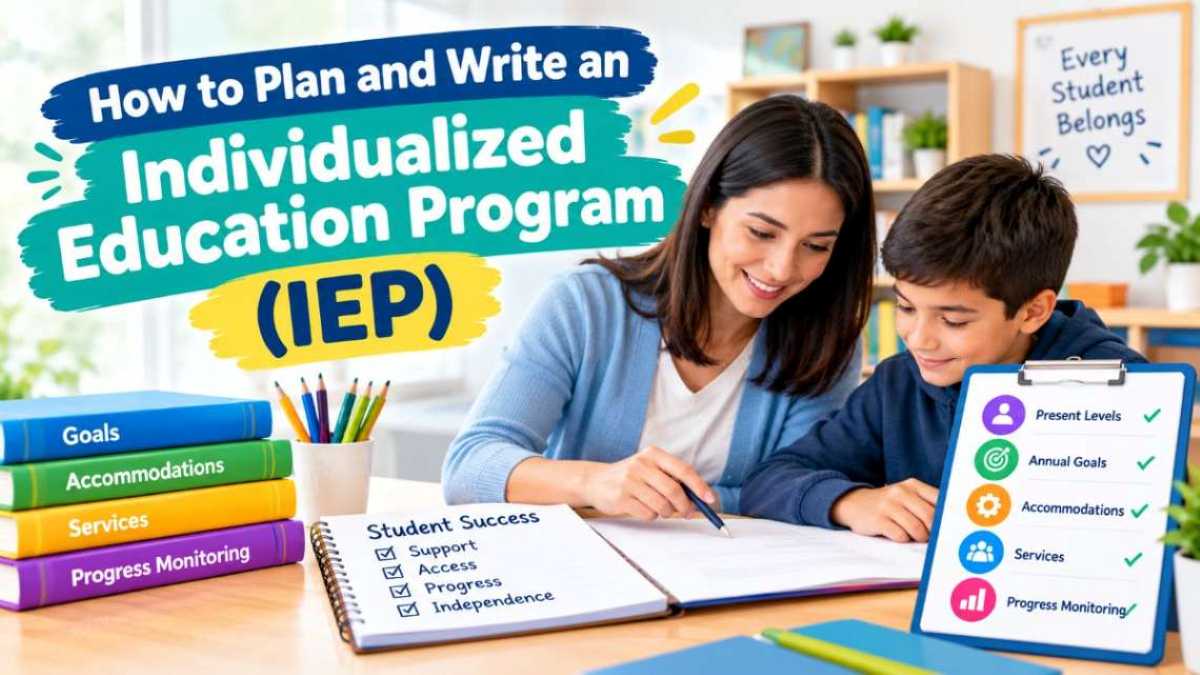
How to Plan and Write an IEP: Step-by-Step Guide
Planning and writing an Individualized Education Program (IEP) requires teachers, parents, special education professionals, and other relevant team members to identify a student’s educational needs and develop a practical plan to address them. A well-written IEP connects the student’s current performance with measurable goals, appropriate services, classroom accommodations, and a clear process for monitoring progress.
In the United States, an IEP is developed under the Individuals with Disabilities Education Act (IDEA) for eligible students with disabilities who need special education and related services. The plan must reflect the individual student’s needs rather than rely on a generic template.
This guide explains how to plan and write an IEP step by step, with examples of present-level statements, measurable goals, accommodations, progress-monitoring methods, and a practical IEP writing template.
What Should You Prepare Before Writing an IEP?
Before drafting the document, collect the information needed to understand the student’s current performance and educational needs.
Prepare the following:
- Relevant evaluation and assessment results
- Current academic performance and classroom work samples
- Information about the student’s strengths, interests, and learning preferences
- Existing progress-monitoring data
- Input from parents or guardians
- Observations from general education teachers and specialists
- Information about communication, behavior, independence, or functional skills when relevant
- Details of existing services, accommodations, and assistive technology
- Curriculum expectations and the student’s participation in classroom activities
In the United States, the IEP team must follow applicable IDEA evaluation, eligibility, meeting, and documentation requirements. A diagnosis alone does not determine eligibility or establish which services a student needs.
The goal of preparation is to ensure that every major part of the IEP is based on reliable information about the individual student.
Step 1: Identify the Student’s Strengths and Educational Needs
Start by identifying what the student can do successfully and where additional support is needed.
Avoid describing the student only in terms of difficulties. Strengths, interests, preferred ways of learning, and successful strategies can help the team design effective instruction.
Consider the following areas:
| Area | Information to collect |
|---|---|
| Reading | Word recognition, fluency, comprehension, and vocabulary |
| Writing | Sentence construction, organization, spelling, and written expression |
| Mathematics | Calculation, problem-solving, reasoning, and mathematical language |
| Communication | Expressive language, receptive language, and communication methods |
| Social participation | Interaction, collaboration, and participation in classroom routines |
| Behavior and self-regulation | Observable behaviors, triggers, successful supports, and coping strategies |
| Functional skills | Independence, organization, transitions, and daily school routines |
| Access to learning | Assistive technology, accessible materials, mobility, and environmental needs |
Not every IEP requires goals in every area. Include the areas supported by the student’s evaluation, present performance, and identified educational needs.
Example
A student may understand scientific concepts during class discussion but struggle to explain them in writing. The IEP team should recognize the student’s conceptual understanding while identifying written expression as a potential area requiring further assessment and support.
This distinction helps prevent the team from confusing a difficulty with one method of demonstrating learning with a lack of subject knowledge.
Step 2: Write the Present Levels of Academic Achievement and Functional Performance
The present levels section, often called PLAAFP, describes the student’s current academic and functional performance and explains how the disability affects participation and progress in the general education curriculum.
This section provides the baseline for selecting goals and services.
A useful present-level statement includes:
- The skill being assessed.
- The student’s current performance.
- Evidence supporting that performance.
- The effect of the identified difficulty on educational participation or progress.
- The support or instruction the student may need.
Example of a weak present-level statement
“The student has difficulty with reading comprehension.”
This statement does not explain which reading skills are difficult, how the student performs, or what evidence supports the conclusion.
Improved present-level statement
“During recent reading assessments, the student identified explicitly stated details in short passages but had difficulty making inferences from the text. The student answered 4 out of 10 inference questions correctly across two classroom assessments. This difficulty affects the student’s ability to explain character motivations and draw conclusions from grade-level reading materials. The student benefits from explicit instruction in identifying textual evidence and explaining how it supports an inference.”
This example identifies a specific skill, includes a measurable baseline, explains the educational impact, and points toward an instructional need.
Use actual student data when writing an IEP. The numbers above are illustrative and should not be copied as though they describe a real student.
Step 3: Select Priority Needs for the IEP
Once the present levels are written, identify the needs that require individualized instruction, services, or support.
Not every classroom difficulty requires a separate IEP goal. The team should consider the evaluation evidence, educational impact, individual needs, and relationship between the need and the proposed services.
For each identified need, ask:
- What skill does the student need to develop?
- How does the difficulty affect educational progress or participation?
- What evidence supports this need?
- Can the skill be measured?
- What instruction or support could help the student improve?
- How will the team determine whether the support is effective?
Example
| Identified need | Possible educational response |
|---|---|
| Difficulty making inferences when reading | Explicit comprehension instruction and a measurable reading goal |
| Difficulty organizing written paragraphs | Writing instruction, planning supports, and a written-expression goal |
| Difficulty accessing printed materials | Appropriate accessible formats or assistive technology |
| Difficulty communicating requests | Communication supports and, when appropriate, a measurable communication goal |
The team should determine the appropriate response for each student. The table provides planning examples, not automatic service recommendations.
Step 4: Write Measurable Annual IEP Goals
Annual goals describe what the student is expected to achieve during the IEP period. Under IDEA, the goals must address the student’s disability-related educational needs.
A useful goal specifies the target skill, the conditions under which it will be demonstrated, the expected performance, and the timeframe.
A practical goal-writing formula
Given [condition or support], the student will [observable skill] at [measurable performance level] by [target date], as measured by [assessment or data-collection method].
This formula is a planning aid, not a substitute for the applicable legal requirements or the professional judgment of the IEP team.
Example 1: Reading comprehension
Present level: The student answered 4 out of 10 inference questions correctly across two recent classroom assessments.
Annual goal: Given a grade-appropriate instructional passage, the student will answer inference questions and support answers with relevant textual evidence, meeting the individualized performance criterion established by the IEP team across three consecutive progress-monitoring assessments by the end of the IEP period.
Progress monitoring: Use comparable reading-comprehension assessments and record both accuracy and use of textual evidence.
Example 2: Written expression
Present level: The student can generate relevant ideas verbally but has difficulty organizing them into a complete paragraph.
Annual goal: Given a writing prompt and the agreed planning support, the student will write an organized paragraph containing a topic sentence, supporting details, and a concluding sentence in four out of five assessed opportunities by the end of the IEP period.
Progress monitoring: Review writing samples using a consistent rubric and record whether each required component is present.
Example 3: Mathematics
Present level: The student can solve single-step addition problems but struggles to solve the targeted class of multistep problems independently.
Annual goal: Given problems involving the identified multistep mathematics skill, the student will select appropriate operations, complete the calculations, and show the required reasoning at the performance level established by the IEP team by the target date.
Progress monitoring: Use curriculum-based assessments that measure operation selection, calculation accuracy, and mathematical reasoning.
Example 4: Communication
Present level: During classroom activities, the student does not consistently communicate when assistance or clarification is needed.
Annual goal: During specified classroom activities, the student will use the agreed communication method to request assistance or clarification in four out of five observed opportunities across the defined monitoring period.
Progress monitoring: Use a structured observation record and document the opportunities, communication attempts, and level of prompting.
What makes an IEP goal effective?
An effective goal is:
- Individualized to the student’s assessed needs
- Connected to the present level of performance
- Observable and measurable
- Appropriate to the student’s baseline and educational context
- Linked to a clear method of progress monitoring
- Written so that teachers and families can understand the intended outcome
Avoid goals such as “the student will try harder,” “the student will improve,” or “the student will understand mathematics” unless they are rewritten to describe observable performance.
Step 5: Determine the Special Education Services and Supports
After identifying the student’s needs and goals, the IEP team determines which special education services, related services, supplementary aids, and supports are required.
The services should be connected to the student’s needs rather than selected from a standard list.
Depending on the individual circumstances, the plan may address:
- Specialized reading or mathematics instruction
- Speech-language services
- Occupational or physical therapy
- Counseling or other appropriate related services
- Assistive technology
- Accessible instructional materials
- Supplementary aids and classroom supports
- Support for participation in general education activities
Under IDEA, the IEP must specify the required service details, including frequency, location, and duration, as applicable.
Example
If the student needs specialized instruction to develop reading-comprehension skills, the IEP should describe the service and the required delivery details rather than simply state “provide reading help.”
The actual service, setting, and schedule must be determined by the IEP team according to the student’s individual needs and applicable requirements.
Step 6: Write the Accommodations and Supplementary Aids
Accommodations help a student access instruction or demonstrate learning. They should address an identified barrier and be written clearly enough for staff to implement consistently.
Examples include:
- Providing written and verbal directions
- Using accessible text or digital reading materials
- Providing additional time where appropriate
- Allowing an approved assistive technology tool
- Using a visual schedule
- Breaking complex directions into manageable steps
- Providing an appropriate assessment environment
- Using an agreed communication system
Weak accommodation
“Give the student extra help.”
Improved accommodation
“Provide written and verbal directions for multistep classroom assignments and check that the student understands the first step before independent work begins.”
The improved statement explains what the teacher should do and when to do it.
Accommodations should be selected individually. Do not assume that every student with the same disability needs the same support, and ensure that assessment accommodations comply with applicable testing rules.
Step 7: Plan How Progress Will Be Measured
An IEP is incomplete as a practical instructional plan if the team cannot determine whether the student is progressing toward the goals.
For each goal, specify:
- The skill being measured
- The assessment or observation method
- The schedule for collecting data
- The performance criterion
- How and when progress will be reported to parents
Choose a measurement method that matches the goal.
| Goal area | Possible progress-monitoring method |
|---|---|
| Reading fluency | Regular reading passages with accuracy and rate records |
| Reading comprehension | Comprehension questions and analysis of textual evidence |
| Written expression | Writing samples assessed with a consistent rubric |
| Mathematics | Curriculum-based probes and recorded problem-solving accuracy |
| Communication | Structured observations of communication opportunities |
| Task completion | Checklist recording steps completed and prompting required |
For example, if a student has a writing goal, the teacher might review a writing sample every two weeks using the same rubric. The resulting data can show whether organization, sentence structure, or use of supporting details is improving.
The IEP team should use progress data to make informed decisions. If the student is not making expected progress, the team may need to review the instruction, supports, implementation, or goal itself.
Step 8: Plan Participation in General Education
The IEP should explain how the student will access the general education curriculum and participate in school activities with appropriate supports.
IDEA requires consideration of the least restrictive environment. Students with disabilities should be educated with students without disabilities to the maximum extent appropriate, with removal from regular education occurring only when education in regular classes cannot be achieved satisfactorily with supplementary aids and services.
When planning, consider:
- Which classroom activities the student can access with support
- Whether instructional materials need to be adapted
- Whether assistive technology is required
- How the student will participate in assessments
- Whether supplementary aids can support participation
- How services will be coordinated across settings
The team should base placement decisions on the student’s individual needs and applicable requirements rather than automatically assigning students to separate settings based on a diagnosis.
Step 9: Review the IEP With the Team and Family
Before finalizing the plan, review whether its parts work together.
Use the following questions:
- Does the present-level statement include meaningful evidence?
- Does every goal address an identified educational need?
- Can each goal be measured consistently?
- Are the proposed services connected to the goals and identified needs?
- Are accommodations written clearly?
- Is the progress-monitoring method suitable for each goal?
- Are the responsibilities of the relevant school personnel clear?
- Has the team considered the student’s strengths and participation in general education?
- Have parents had an opportunity to contribute and ask questions?
In the United States, the IEP must be developed, reviewed, and implemented in accordance with IDEA. The required team members and procedural protections must be observed.
The review should also ensure that the document uses clear language. A plan should be understandable to the people who will implement it and the family whose child it supports.
Step 10: Implement, Monitor, and Revise the IEP
Once the IEP is finalized, the relevant staff must implement the program according to applicable requirements.
Teachers should understand the provisions relevant to their responsibilities, provide the specified accommodations and services, and collect progress data as planned.
The team should review progress reports and consider whether the student is moving toward the annual goals.
If the student is making limited progress, investigate the reason before changing the goal automatically. Consider whether the instruction is appropriate, whether supports are being implemented consistently, and whether the assessment accurately measures the intended skill.
Under IDEA, the IEP must be reviewed periodically, at least annually, and revised as appropriate. Changes may also be needed sooner when the student’s needs or circumstances warrant them.
Individualized Education Program (IEP) Writing Template
Use this template as a planning aid when preparing information for an IEP team. It does not replace an official school or district form, required evaluations, or the legal procedures that apply to the student.
1. Student information
- Student name:
- Grade:
- School:
- Date of IEP meeting:
- IEP period:
- Relevant evaluation information:
2. Student strengths and interests
Describe the student’s academic strengths, interests, preferred activities, successful strategies, and relevant personal strengths.
Planning notes:
[Describe the student’s strengths and interests.]
3. Present levels of academic achievement and functional performance
For each relevant area, describe current performance, supporting evidence, and the effect of the disability on educational participation and progress.
Area of need:
[Reading, writing, mathematics, communication, functional skills, or another identified area.]
Current performance and baseline:
[Include relevant assessment results and classroom evidence.]
Educational impact:
[Explain how the identified difficulty affects learning or participation.]
4. Measurable annual goal
Identified need:
[Describe the specific skill the student needs to develop.]
Goal statement:
Given [condition or support], the student will [observable skill] at [measurable performance level] by [target date].
Progress-monitoring method:
[Specify the assessment, observation, or data-collection method.]
Progress-reporting schedule:
[Specify how and when progress will be reported, consistent with applicable requirements.]
5. Special education and related services
- Service:
- Purpose:
- Frequency:
- Location:
- Duration:
- Responsible provider or role:
Complete these details according to the student’s needs and applicable requirements.
6. Accommodations and supplementary aids
| Identified barrier | Accommodation or support | When or where it applies |
|---|---|---|
| [Barrier] | [Specific support] | [Relevant setting or activity] |
| [Barrier] | [Specific support] | [Relevant setting or activity] |
7. Participation and assessment arrangements
Describe how the student will participate in general education and school activities, and document applicable assessment participation and accommodations.
8. Progress monitoring
- Goal being measured:
- Baseline:
- Measurement tool:
- Data-collection schedule:
- Performance criterion:
- Reporting arrangements:
9. Team review
Confirm that the plan addresses the student’s identified needs, includes measurable goals, specifies the required services and supports, and explains how progress will be monitored.
Important: This is a working template, not a substitute for the official IEP document used by the student’s school or district.
Common Mistakes to Avoid When Writing an IEP
Writing goals without baseline data: A goal is difficult to evaluate when the team has not documented the student’s current performance.
Using vague language: Statements such as “improve behavior” or “get better at reading” do not specify what the student will do or how progress will be measured.
Selecting accommodations without a clear reason: Supports should address identified barriers rather than be copied from another student’s plan.
Failing to connect goals and services: The team should be able to explain how the planned instruction and services support the student’s educational needs and goals.
Using inappropriate measurement methods: The data-collection method should assess the skill named in the goal.
Ignoring the student’s strengths: Strengths and interests can inform meaningful instruction and help the student engage in learning.
Failing to review progress: Data should inform decisions about instruction and whether the plan needs revision.
Conclusion
Planning and writing an effective Individualized Education Program requires a clear understanding of the student’s strengths, present performance, educational needs, and required support.
The process begins with reliable information and continues through measurable goal development, service planning, accommodations, progress monitoring, and regular review. Each component should contribute to one coherent educational program rather than exist as an isolated section of a document.
For teachers and school teams, the most important principle is to connect what the student can currently do, what the student needs to learn, what support will be provided, and how progress will be measured.
A thoughtfully developed IEP gives educators and families a shared framework for supporting the student’s access, participation, and educational progress.