
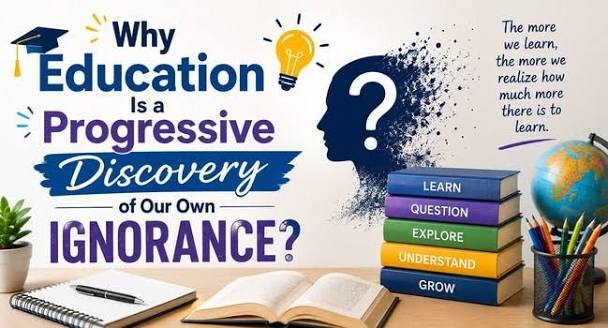
Education Is a Progressive Discovery of Your Own Ignorance
“Education is a progressive discovery of our own ignorance.”
This thought, often attributed to Will Durant, captures one of the most interesting truths about learning: the more we learn, the more we recognize how much we still do not know.
At first, this idea may sound negative.
Why would education help us discover our ignorance?
Shouldn’t education make us feel more knowledgeable and confident?
Yes, it should. But real education does something else, too. It changes our understanding of what we know, what we do not know, and what we still need to explore.
A young student may believe that they understand how the world works. As they study science, history, mathematics, literature, or philosophy, they begin to encounter more complex questions. Each answer leads to another question.
The learning journey continues.
That is why education does not simply fill our minds with facts. It also teaches us to recognize the limits of our knowledge.
This blog is for general information; however, students may ask this question or may know the person who said this. So as a teacher you must have in-depth knowledge about this quote. Muhammad Saeed Akhter (Lead Editor)
Who Said “Education Is a Progressive Discovery of Our Own Ignorance”?
The quote “Education is a progressive discovery of our own ignorance” is widely attributed to Will Durant.
Will Durant was an American historian and philosopher best known for The Story of Civilization, a monumental historical work he wrote with his wife, Ariel Durant.
The quotation appears in collections of Durant’s sayings and is frequently associated with his broader thinking about education, knowledge, and human understanding.
However, teachers and writers should treat famous quote attributions carefully. Online sources often repeat quotations without providing the original publication or context.
When publishing the quotation, it is best to identify it as “widely attributed to Will Durant” unless you have verified the wording against a reliable primary source.
The idea itself, however, has a much longer intellectual history.
Philosophers have explored the relationship between knowledge and ignorance for centuries.
What Does the Quote Actually Mean?
The phrase contains three important ideas:
- Education
- Progressive
- Discovery of our own ignoranc
I am going to explain each in detail below:
Education
Education involves more than attending school or earning a degree.
It includes the lifelong process of learning through:
- Reading
- Experience
- Observation
- Discussion
- Research
- Practice
- Reflection
Education helps us build knowledge and develop ways to think.
But it also changes the way we understand what we know.
Progressive
The word progressive means something that develops gradually over time.
Education rarely gives us complete understanding in one step.
Instead, learning happens in stages.
A child learns basic mathematics.
Later, the child learns algebra.
Then geometry.
Then statistics or calculus.
Each stage builds on earlier knowledge while revealing new areas of complexity.
The same pattern appears in almost every field.
The more deeply we study something, the more complicated it becomes.
Discovery of Our Own Ignorance
Here, “ignorance” does not mean stupidity.
It simply means a lack of knowledge or understanding.
Everyone has gaps in knowledge.
The difference lies in whether we recognize those gaps.
Education helps us identify what we do not yet understand.
For example, a student may begin a biology course believing that the human body works in relatively simple ways.
After studying biology, the student discovers complex interactions between cells, genes, hormones, organs, and environmental factors.
The student now knows more biology than before.
Yet the student also understands how much more remains to learn.
That’s the paradox.
Learning increases knowledge while also expanding awareness of what we do not know.
The Paradox of Learning
One of the most interesting aspects of education is that knowledge can make us more aware of our limitations.
Imagine a person who knows very little about astronomy.
They may look at the night sky and think:
“There are stars and planets. That’s fascinating.”
Now imagine someone who studies astronomy.
They learn about:
- Galaxies
- Black holes
- Stellar evolution
- Dark matter
- Planet formation
- Cosmic expansion
The second person knows far more about the universe.
But they also understand how many unanswered questions remain.
They may ask:
- What exactly is dark matter?
- How did the universe begin?
- Are we alone in the universe?
- What happens inside a black hole?
Knowledge has not eliminated mystery.
It has revealed more of it.
Education Teaches Us to Ask Better Questions
One of the clearest signs of learning is not always the ability to provide answers.
Sometimes it is the ability to ask better questions.
A young child might ask:
“Why is the sky blue?”
A science student might ask:
“How does the atmosphere scatter different wavelengths of light?”
A physicist might ask:
“How do atmospheric composition and light scattering interact under different conditions?”
The question becomes more precise as understanding grows.
This is one reason education matters.
It does not simply give students answers.
It improves the quality of their questions.
From “I Know” to “I Need to Learn”
A beginner often approaches a topic with confidence.
They may think:
“I understand this.”
As they study the subject more deeply, they may begin to say:
“I understand the basics, but I still have questions.”
Eventually, an expert may say:
“I know a great deal about this field, but there is still much I do not understand.”
This does not represent failure.
It represents intellectual maturity.
A knowledgeable person recognizes the boundaries of their understanding.
An uneducated person may not even realize those boundaries exist.
The Dunning Kruger Effect and Education
This idea also connects loosely with the Dunning Kruger effect, a psychological phenomenon associated with research by David Dunning and Justin Kruger.
Their research examined how people with limited knowledge or skill can sometimes overestimate their abilities because they lack enough understanding to recognize their mistakes.
As people gain knowledge and develop better self awareness, they may become more accurate in judging their own abilities.
However, the Dunning Kruger effect often gets oversimplified online.
It does not mean that everyone who lacks knowledge automatically thinks they are an expert.
It highlights a more specific problem: people may struggle to recognize their own errors when they lack the knowledge needed to evaluate their performance accurately.
Education can help by giving learners the knowledge and feedback they need to evaluate their own understanding more realistically.
Why This Idea Matters for Teachers
Teachers can use this idea to rethink what success looks like in education.
A student who says:
“I don’t know yet, but I want to find out.”
may demonstrate more intellectual growth than a student who confidently gives an incorrect answer without questioning it.
Teachers can create classrooms where students feel comfortable saying:
- “I don’t understand.”
- “I need more evidence.”
- “I’m not sure.”
- “Can we investigate this?”
- “What would happen if…?”
- “I changed my mind because of the evidence.”
These statements show curiosity and intellectual honesty.
The Importance of Intellectual Humility
Education can help students develop intellectual humility.
Intellectual humility means recognizing that our knowledge has limits.
It does not mean doubting everything.
It means being willing to say:
- “I might be wrong.”
- “I need more evidence.”
- “I don’t know.”
“I changed my mind after learning something new.”
This mindset helps students learn more effectively because they remain open to new information.
It also helps them evaluate information more carefully.
How Teachers Can Encourage This Mindset
Teachers can build intellectual humility through everyday classroom practices.
Ask Students What They Do Not Know
At the end of a lesson, ask:
“What question do you still have?”
This question shifts attention from what students remember to what they still want to understand.
Use “I Used to Think, Now I Think”
Ask students to complete:
“I used to think…”
“Now I think…”
“What changed my thinking was…”
This activity encourages reflection.
Reward Good Questions
Do not focus only on correct answers.
Recognize thoughtful questions that reveal curiosity and deeper thinking.
Normalize Uncertainty
Tell students that uncertainty can be part of learning.
Science, history, and many other disciplines contain unanswered questions.
Students should learn that not knowing something is often the beginning of investigation.
Education Expands the Boundaries of What We Know
Imagine knowledge as a circle.
Inside the circle lies everything you currently understand.
Outside the circle lies everything you do not know.
As your knowledge grows, the circle becomes larger.
But the boundary between what you know and what you do not know also expands.
You begin to encounter more questions.
This explains why highly educated people often speak carefully about complex subjects.
They understand the complexity.
A beginner may see a simple answer.
An expert may see ten additional questions.
The expert’s uncertainty does not necessarily mean they know less.
It may mean they understand more.
Imagine a teacher introduces climate change to a group of students.
At the beginning, a student may say:
“Climate change means the Earth is getting warmer.”
That statement captures part of the issue.
After studying the topic, the student learns about:
- Greenhouse gases
- Atmospheric systems
- Ocean heat
- Ice loss
- Feedback mechanisms
- Climate models
- Natural climate variability
- Human influences
The student now understands that climate change involves a complex system.
The original answer was simple.
The new understanding is more detailed.
But the student also discovers new questions.
That’s education in action.
The student learned more and became more aware of the subject’s complexity
Why Experts Often Say “It Depends”
Students sometimes expect experts to provide simple answers.
But experts often respond with:
“It depends.”
Why?
Because they understand the variables involved.
A doctor may say that treatment depends on the patient’s condition.
An engineer may say that the best design depends on the materials and environment.
A historian may say that the interpretation depends on the evidence and context.
A scientist may say that more research is needed.
These answers do not necessarily show uncertainty or weakness.
They often demonstrate an understanding of complexity.
Education Should Create Curiosity, Not Just Certainty
A strong education system should give students confidence in what they know while helping them remain curious about what they do not know.
Students should leave the classroom thinking:
“I understand this concept.”
But also:
“What else can I discover?”
That balance matters.
Too much certainty can lead to intellectual rigidity.
Too much doubt can prevent action.
Good education helps students develop both confidence and curiosity.
The Role of Lifelong Learning
The idea behind this quote extends beyond school.
Learning does not stop when students graduate.
People continue learning through:
- Careers
- Reading
- Travel
- Relationships
- Research
- Personal experiences
- New technologies
The world changes constantly.
New discoveries challenge old assumptions.
New technologies create new questions.
Lifelong learning helps people adapt.
The more we learn, the more we recognize that education is not a destination.
It is an ongoing process.
What Students Can Learn From This Idea
The quote offers several important lessons for students.
1. You Do Not Need to Know Everything
No one knows everything.
Learning involves accepting that you have gaps in your knowledge.
2. Asking Questions Is a Strength
Questions show curiosity.
They often lead to deeper understanding.
3. Changing Your Mind Can Be a Sign of Growth
When new evidence changes your thinking, updating your position can demonstrate learning.
4. Experts Keep Learning
Expertise does not mean knowing everything.
It means understanding a subject deeply enough to recognize its complexity.
5. Curiosity Can Drive Learning
The questions you ask today may lead to discoveries tomorrow.
A Simple Activity for Teachers
Teachers can turn the quote into a reflection activity.
Write on the board:
“Education is a progressive discovery of our own ignorance.”
Ask students to answer:
- What did you know about this subject before the lesson?
- What do you know now?
- What did you discover that you did not know before?
- What question do you still have?
This activity helps students see learning as a process.
They can recognize both their progress and their remaining questions.
Final Thoughts
The idea that education is a progressive discovery of our own ignorance captures a powerful truth about learning.
Education does not simply give us more answers.
It helps us understand the questions we did not know to ask.
It teaches us to recognize the limits of our knowledge, question our assumptions, examine evidence, and remain open to learning.
For teachers, this idea offers an important reminder.
The goal of education should not be to make students believe they know everything.
It should help them become confident learners who can say:
“I know what I know. I recognize what I don’t know. And I’m willing to keep learning.”
That may be one of the clearest signs of a truly educated mind.